Saturday, 7 August 2010

Portrait of Richard Feynman

Richard Feynman (1918 –1988), one of the most brilliant theoretical physicists of this last century was also one of our greatest minds.
In 1965 he received the Nobel Prize in Physics for his contributions to the development of quantum electrodynamics (QED), jointly with Julian Schwinger and Sin-Itiro Tomonaga. He developed a widely used visual representation for the mathematical expressions governing the behaviour of subatomic particles, which later became known as “Feynman diagrams”. Yet Feynman despised honours and “academic” authorities. He even considered refusing his Prize!

Feynman was not just “another scientist”, he was a larger-than-life character.
His contributions were not limited to science but were also artistic. He was indeed a good painter, a poet and an enthusiast bongo player!
His innate "child-like” curiosity and creativity caused him to be “labelled” a “genius”.
His personality was as summed up by General Donald Kutyna: "Feynman had three things going for him. Number one, tremendous intellect and that was well known around the world. Second, integrity…..Third, he brought this driving, desire to get to the bottom of any mystery. No matter where it took him, he was going to get there, and he was not deterred by any roadblocks in the way. He was a courageous guy, and he wasn't afraid to say what he meant."

Unlike Professor Steven Hawking, I couldn’t have had the chance to ever meet Richard Feynman. However his writings, his filmed interviews, his recorded lectures, his drawings, paintings and poems have survived. They were all created by the same mind and can reach us as if still alive.

Helped with pictures or videos available on the Internet, I tried to capture his colourful and engaging personality: intense, deep yet frivolous.

The background looks like the “chaos” of particles collisions. This is no accident. I used here a technique similar to a Jackson Pollock’s “dripping paint”. But unlike Pollock, I didn’t stop there.

In my portrait of Feynman, his body posture has a Y shape. This is my preferred letter. I believe this was his too.
Here is one of his poems:

I wonder why?
I wonder why?
I wonder why I wonder?
I wonder why I wonder why I wonder why I wonder?
(In "Surely you're joking, Mr. Feynman!")


"The Art of Richard P. Feynman". Compiled by Michelle Feynman.
More from my upcoming book "The eye inside


My portrait of Richard Feynman


Richard Feynman (1918 –1988), one of the most brilliant theoretical physicists of this last century was also one of our greatest minds.

Unlike Professor Steven Hawking, I couldn’t have had the chance to ever meet Richard Feynman. However his writings, his filmed interviews, his recorded lectures, his drawings, paintings and poems have survived. They were all created by the same mind and can reach us as if still alive.

Helped with pictures or videos available on the Internet, I tried to capture his colourful and engaging personality: intense, deep yet frivolous.

The background looks like the “chaos” of particles collisions. This is no accident. I used here a technique similar to a Jackson Pollock’s “dripping paint”. But unlike Pollock, I didn’t stop there.

In my portrait of Feynman, his body posture has a Y shape. This is my preferred letter. I believe this was his too.


Here is one of his poems: 

I wonder why?
I wonder why?
I wonder why I wonder?
I wonder why I wonder why I wonder why I wonder?
(In "Surely you're joking, Mr. Feynman!")

Tuesday, 27 July 2010

Homage to Vincent Van Gogh


Exactly 120 years ago, in July 27, 1890, Vincent Van Gogh walked out into the fields around Auvers-sur-Oise and shot himself in the chest with a revolver. He died two days later.
Yet, by all our criteria of "success", Van Gogh was a failure.
Before deciding to become an artist, he had had two unsuitable and unhappy romances and had worked unsuccessfully as a clerk in a bookstore, as an art salesman, and a preacher in Belgium. In 1886 he went to Paris to join his brother Théo, the manager of Goupil's gallery and to study Art. He encountered the Impressionists and began to lighten his very dark palette.
He decided to go south to Arles where he hoped his friends would join him and help found a school of art with Gauguin. A violent row started between the two which led to total disaster. After the row, Van Gogh ended up cutting a portion of his own ear lobe off, wrapped it in newspaper, and gave it to a prostitute named Rachel. In May of 1890, he was sent to the asylum in Saint-Remy for treatment where he met with Dr Gachet and where he painted "The Starry Night," one of his most famous paintings.
Some two months later he was dead, having shot himself "for the good of all."  He felt a burden to his brother’s family, and a failed artist.
The Red Vineyard
Van Gogh's finest works were produced during his three last years. He produced over 2,000 works and sold only one during his life: The Red Vineyard.
Although today, these paintings can fetch tens of millions of $ at auction and enrich many collectors, they were worthless during his lifetime. Nobody bought them. One day, he even begged for meat to his butcher against one of his paintings. The butcher refused his offer. 
History is cruel. His Doctor Gachet portrait was sold in auction for $82.5 million, an auction record. A Japanese industrialist multimillionaire Ryoei Saito bought it and took it to Tokyo, where he left it unseen by anyone for seven years. He joked about his wish to get the famous painting cremated with him. Since he died in 1995, nobody really knows who is the new owner of Dr. Gachet portrait or its location.

I have painted a portrait of Dr. Gachet with a melancholy expression, which might well seem like a grimace to those who see it. . . . Sad but gentle, yet clear and intelligent, that is how many portraits ought to be done. . . . There are modern heads that may be looked at for a long time, and that may perhaps be looked back on with longing a hundred years later.
VINCENT VAN GOGH, JUNE 1890


The best way to learn from a master like Van Gogh is to copy him. So did I and as homage, I chose for my painting’s quiet backdrop his Noon, or The Siesta, (after Millet, 1890). 
I used real gold paint instead of his so-called “Van Gogh’s yellows” to paint hays.
I believe had he the opportunity, he would have used it as he was a fond admirer of Asiatic and Japanese art.
Depending on the gold’s reflections and your angle's viewpoint, you will see Vincent’s dying and (logically)  colorless body to appear or disappear... 
I also found his brush technique very energetic yet easier and more natural than I thought (no wonder he painted so many pictures!). He clearly loved hays as it is natural for his brush strokes technique.
I also understood that when he was painting colors, they were not just “vibrating” but also very "material". Van Gogh was treating light and colours as he would have treated concrete matter, and vice-versa. In Van Gogh’s mind light was BOTH a wave (vibration) and a particle (matter). It was a sort of artist’s take on the “wave-particle” famous scientific paradox.

Epitaph:

The true artist is living on the edge of life, like walking a tightrope with no net.
He is admired for his incredible aerial feats, his freedom yet his admirers hope he will fall, he will fail. This is their thrill. This is why he is tapped on the back in hope one day he will.

Van Gogh fell but didn't fail.


Tuesday, 13 July 2010

My "Pillars of Creation"

 I am not a landscape painter but since the releases of the Hubble Space Telescope’s pictures, galaxies and other nebulae have become part of our landscape. The central subject of my painting is the "Pillars of Creation", located in The Eagle Nebula (M16, NGC 6611). Released in April 1995, they are Hubble Space Telescope’s most famous picture. The M16 is approximately 7,000 light years away and is approximately 24 trillion miles long.
My painting is a 360 degrees panorama which has therefore no fixed central viewpoint. It is however viewed from one single observer living on our planet Earth.
I have therefore painted it from all possible angles, turning the canvas on all its four possible positions (therefore these four views of my painting). This painting can be appreciated from any angle, hopefully superseding the limited "Cubist perspective" attempted a century ago.
As a so-called "fish-eye" panorama, its positive curvature reflects the curvature of our expanding (inflationary) universe.
The "Pillars" patterns can also be found amongst the clouds above the sun (sorry but my photograph isn't good enough to see them well). These are "Pillars-like clouds" BUT with quite literally a twist: they are inverted as in a mirror. My idea here is to suggest the idea of a relation between what Ancient philosophers called Macrocosm&Microcosm. In Ancient Egypt, our "Milky Way" was considered as a celestial copy of the "earthly Nile", a place where all dead's souls end their journey. 
I liked this metaphor: we are but a reflection of a much bigger world. We are mere stardust.
Viewed at some distance, the circle of the panorama can also be seen as either an outside or inside "sphere"- my artistic rendering of the concept of a "boundless yet finite" Universe.
I hope that at this point you feel a little bit dizzy... 
The circle of the panorama can also be seen as a clock. If you look a little bit closer you will realize it is being populated by Life's activities over a span of... several millions years. The central subject being, after all, the "Pillars of Creation". We are all ephemeral stardust, are we not?
So it is all about time + space ... in a nutshell.
The irony is that this image of these "Pillars of Creation" isn't eternal either. In 2007 an infrared image from the Spitzer Space Telescope revealed a previously unknown supernova whose shock wave may have destroyed the Pillars approximately 6,000 years ago. 
Given the distance to the nebula, we have another 1,000 years to enjoy this striking beauty.
Since I won't live long enough, I thought it would be a good idea to portray it.

This painting of Vincent Van Gogh (The Starry Night) was an obvious inspiration.


My "Pillars of Creation"

 I am not a landscape painter but since the releases of the Hubble Space Telescope’s pictures, galaxies and other nebulae have become part of our landscape. The central subject of my painting is the "Pillars of Creation", located in The Eagle Nebula (M16, NGC 6611). Released in April 1995, they are Hubble Space Telescope’s most famous picture. The M16 is approximately 7,000 light years away and is approximately 24 trillion miles long.
My painting is a 360 degrees panorama which has therefore no fixed central viewpoint. It is however viewed from one single observer living on our planet Earth.
I have therefore painted it from all possible angles, turning the canvas on all its four possible positions (therefore these four views of my painting). This painting can be appreciated from any angle, hopefully superseding the limited "Cubist perspective" attempted a century ago.
As a so-called "fish-eye" panorama, its positive curvature reflects the curvature of our expanding (inflationary) universe.
The "Pillars" patterns can also be found amongst the clouds above the sun (sorry but my photograph isn't good enough to see them well). These are "Pillars-like clouds" BUT with quite literally a twist: they are inverted as in a mirror. My idea here is to suggest the idea of a relation between what Ancient philosophers called Macrocosm&Microcosm. In Ancient Egypt, our "Milky Way" was considered as a celestial copy of the "earthly Nile", a place where all dead's souls end their journey. 
I liked this metaphor: we are but a reflection of a much bigger world. We are mere stardust.
Viewed at some distance, the circle of the panorama can also be seen as either an outside or inside "sphere"- my artistic rendering of the concept of a "boundless yet finite" Universe.
I hope that at this point you feel a little bit dizzy... 
The circle of the panorama can also be seen as a clock. If you look a little bit closer you will realize it is being populated by Life's activities over a span of... several millions years. The central subject being, after all, the "Pillars of Creation". We are all ephemeral stardust, are we not?
So it is all about time + space ... in a nutshell.
The irony is that this image of these "Pillars of Creation" isn't eternal either. In 2007 an infrared image from the Spitzer Space Telescope revealed a previously unknown supernova whose shock wave may have destroyed the Pillars approximately 6,000 years ago. 
Given the distance to the nebula, we have another 1,000 years to enjoy this striking beauty.
Since I won't live long enough, I thought it would be a good idea to portray it.

This painting of Vincent Van Gogh (The Starry Night) was an obvious inspiration.


Thursday, 3 June 2010

Disability and Art


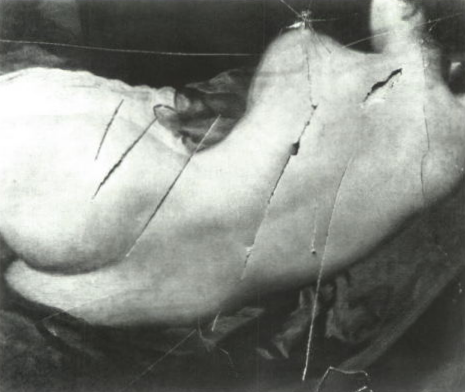
This portrait is of someone whose body is seriously disabled (she is an ALS/MND sufferer). My idea was to be honest about her disability, which for me meant showing her body as it is, without hiding anything yet  in a tactful and respectful manner. So, my solution was inspired by Velásquez's or Rubens' "Venus": a naked "Venus", symbol of femininity BUT showing only her back while... she is watching US via her mirror! So, when visitors (mostly male in those days) were expecting to peep at an attractive naked female body, in fact the situation was reversed: watchers they weren't anymore, they were the watched ones! This painting was very feminist indeed. 
In my painting, because of her handicap, it was decided that the mirror would be locally cracked, hinting at her disabled body.
In Velásquez times (mid 17th century) this painting was so provocative that it managed to escape the Spanish Inquisition only because it remained hidden in a private collection.


Ironically it didn't survive well the 20th century when in 1914, the militant suffragette and feminist Mary Richardson slashed Velásquez's masterpiece in protest of women's situation (see photograph).
This composition seems to unsettle many. The subject of my portrait has refused to "endorse" it. It will  therefore remain anonymous.

More on Velásquez's "Venus" popularity.


Showing disability in an "artistic" manner seems to create controversy.
Disabled artist Alison Lapper did create controversy when a statue of her naked body (born with short legs and no arms) was erected at Trafalgar Square in... 2005. 

Thursday, 13 May 2010

Gold technique revisited

This is my last portrait of Hannah my daughter (the previous one was done four years ago). 


I am using a new technique: background partly painted in gold. Not as a gimmick but as an interesting way to make a portrait look more lively: its appearance changes depending on the angle we look at it. It cannot be shown here with a static pic. Sorry.

This is a traditional media which has been in practice for some 5,000 years, beginning in ancient India and was widely used during the great dynasties of ancient  Egypt and spread in Eastern and Western Europe after the fall of the Roman empire (Byzantine icons and medieval altarpieces).  Asia has also utilized gold-leaf backgrounds in their fine painting (see below: Heron- Song dynasty). 


Gustav Klimt is the most famous European artist of the 20th century to have used gold leaf as a proper mode of his expression, away from its religious tradition in the West (see below: Klimt: the Kiss).
So, in the secular tradition revived by Klimt, I will use it more often as it adds a unique feature to a painting: being more alive and like "reacting" to our presence, from where we are and look.