TED talk by French Buddhist monk Matthieu Ricard: why Empathy is not enough...
Ph.D. degree in molecular genetics at the Pasteur Institute under French Nobel Laureate François Jacob, Matthieu Ricard is the son of renowned French philosopher the late Jean-François Revel.
Showing posts with label Empathy&Compassion. Show all posts
Showing posts with label Empathy&Compassion. Show all posts
Wednesday, 14 October 2015

Friday, 17 July 2015
Tuesday, 17 February 2015
Thursday, 15 January 2015
My Experience Of Citizens' Aid Convoy To Besieged Sarajevo (1992-3)
A Citizens' aid convoy to besieged Sarajevo:
A personal account
© Yves Messer
 I (that is the author of this Blog, Yves Messer) was living then in Strasbourg (Alsace, North-East of France), a city famous for its wine and among other things for hosting the European parliament.
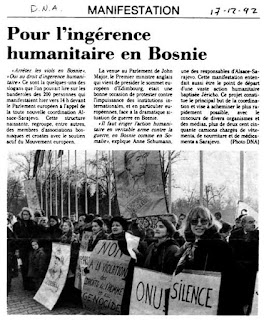 The operation was a success! The day after, we held a meeting to officially create the "Alsace-Sarajevo" association in a room packed with hundreds of people! People of good will, from all walks of life, touched and horrified by what was happening there and angry against their own government (Mitterrand's France was de facto siding with Miloševic's Serbs). They would become the core of the whole operation. Normal citizen would show to the world they do care. They will become one-time heroes of an unprecedented humanitarian operation.
A key person joined us; Ms Anne Schumann who, thanks to her organizing abilities and political connections, helped the operatrion to gear up. Thanks to her, we received the support from a major local political and historical figure and respected from all: Mr Pierre Pflimlin. This was essential for the next stage of the operation: the fundraising.
The practical decision was that we preferred to collect money rather than goods. Why? Because we know from experience that one could be appalled by what people would literally "get rid of" for "charity." We didn't want that. The other reason was time. It would have required far too much time to pack objects of various sizes, sort them out etc... And we were in an emergency situation. The option was to create one standardized "aid-pack" parcel whose size would optimize the space in the trucks, and also guarantee the quality and necessity of their contents: i.e. nonperishable food, products of hygiene (like soap, toilet paper or make-up set for women...), etc... that is for people living in exceptionally rough conditions.
So, one month later, on January 17, the "City Councils Open Day" operation was launched and announced by all local medias, an operation by which local authorities would help us with their staff to collect people's donations.
People were moved to know they could help doing something about what was happening in Sarajevo, however small their contribution was... I remember seeing on TV an old lady, who remembered the Second World War's atrocities, putting some of her small savings in the box, with tears in her eyes and saying to the camera: "Thank you...!"
In total some €880,000 (about US$1 million then) were raised.
With that money we were able to hire lorries and buy some 350 tons of goods for a city of 200,000 people. One parcel per person....
A month later, on February 17, the convoy finally set off (despite some difficulties which delayed it ten more days). The day before, all the lorries were safe-guarded at the Illkirch-Graffenstaden military base. In all, the column was made up of over 60 vehicles: 34 trucks, 12 vans, 6 coaches, 6 4x4, an ambulance and some
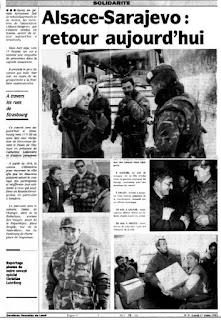
private cars. 130 people were accompanying the convoy: 77 drivers, 40 guides and a dozen of journalists. The convoy would grow bigger progressively: several French and foreign associations would add their trucks to it. A particular effort was made on the safety of the convoy: all the vehicles were in radio connection and a safety leaflet was distributed to all, which detailed attitudes to be adopted in the event of control. Risks exist for this human mission in a country in war, since it wasn't part of the "regular" official aid operations....
The night before, we had a contact with three trucks from Toulouse (South of France), which were like our "scouts". Good news!; they managed to enter to Sarajevo. After Salzburg (Austria), the convoy had to load additional goods at Ljubljana (Slovenia) then to spend the next night to Rijeka, a Croatian port on the Adriatic. Then off to Split, Kiseljak (Bosnia), a station occupied by the UN blue helmets where they would await for the necessary green light to enter to Sarajevo.
Which they did after one week of travel through very hard wheather conditions on February, 24... The drivers were exhausted and sometimes close to mutiny... All of that disappeared at the gates of Sarajevo, the ultimate destination! Now the delivery operation! All of the parcels were stored in 8 different safe places and distributed by local district associations and hospitals. The majority of the drivers were invited in host families, feeling what it is living in cold winter with no running water, no electricity, no heating... The following day we all had to go back to our usual comfort, leaving behind so many emotions from thankful people who realised they weren't completely forgotten... Was that the reason why security was temporarily forgotten? To the exit of Sarajevo, the convoy left without any Bosnian guide and was found itself in ... Dobrinja, the most bombarded and exposed district of Sarajevo!
Eventually they all came back safe on March 1rst...
The lessons are that sometimes, apparently the impossible can be achieved by people like you or me...
As for myself I returned eventually to my home country, Belgium, ... to help organizing yet another demonstration in front of the EEC in Brussels (is this an obsession?). I had then the opportunity to meet somebody who managed to escape from Sarajevo's thanks to his then-Belgian girlfriend (this is another story that was eventually published in a book). He told me he remembered the parcels quite well, "That was good, we were hungry..." he said. He took the chance to study cinema in Brussels (he was one of the Bosnian army cameramen...). In 2002, he won the Oscar for the Best Foreign Language Film for his film "No Man's Land". His name is Danis Tanovic.
Now, I am living in the U.K. and hope this will inspire some.
The Alsace-Sarajevo aid convoy announced on National French TV (TF1)
A personal account
© Yves Messer

It was the time when Europe was watching, impotently, the first war and first crimes against Humanity on its soil since the end of the Second World War: the new strong man of Yugoslavia, Slobodan Miloševic had used “Serbian nationalism” to justify military action against newly independent Yugoslav republics like Slovenia or Croatia. This was 1991, the year that saw the end of Soviet Union. The Yugoslav republic of Bosnia and Herzegovina also declared its independence that year. When they held a referendum for its independence, their vote was boycotted by their sizable Serb population (35% of Bosnian population), which advocated a continued union with Miloševic‘s Yugoslavia. Immediately following the international recognition of the republic's independence in April 1992, the country's Serbs and Croats, backed respectively by Serbia and Croatia, began to claim large chunks of the country's territory. The referendum was however declared valid, the opinion of the Serbs was ignored, and the Bosnian republic's government declared its independence. The Bosnian Serbs immediately declared the independence of their Republika Srpska. Sarajevo, a city famous for hosting the Winter Olympics in 1984, was under siege from Bosnian Serbs and their infamous snipers in the surrounding hills and suburbs. Daily atrocities were committed in front of everybody's eyes...
Being politically involved at the time I had the chance (thanks to common Serbian student friends who were horrified by what was happening to their country) to meet somebody who, like myself, wanted to do something about this tragedy. We wanted to act as Citizens despite the criminal apathy of our governments and institutions. This was December 1992. His name is Yves Dubois, a journalist presenter at the local TV network FR3 and his partner Vera Simic, a former TV presenter from... Sarajevo. He had many, sometimes foolish, ideas but the soundest and most realistic one was to organize and send an Aid convoy to Sarajevo. Such a Citizens' initiative was unprecedented and wasn't to the professional NGO's taste...
At that point he was desperate because of the lack of response from anyone he had contacted so far, especially "established" persons… and was about to give the idea up altogether. I and my partner at the time, Kathrine, proposed him to start with a demonstration and see the people's reactions from there…
We printed out and distributed some 4,000 small leaflets in Strasbourg calling for a protest demonstration against the massacres in Yugoslavia, to be held in front of the European parliament on the 16th of December...
Despite of the lack of time because of the urgency of the situation (he wanted to reach Sarajevo next month...) and despite of the relatively small size of the demonstration, the event was noticeable enough to be covered by the TV news (obviously) and in the local press
Being politically involved at the time I had the chance (thanks to common Serbian student friends who were horrified by what was happening to their country) to meet somebody who, like myself, wanted to do something about this tragedy. We wanted to act as Citizens despite the criminal apathy of our governments and institutions. This was December 1992. His name is Yves Dubois, a journalist presenter at the local TV network FR3 and his partner Vera Simic, a former TV presenter from... Sarajevo. He had many, sometimes foolish, ideas but the soundest and most realistic one was to organize and send an Aid convoy to Sarajevo. Such a Citizens' initiative was unprecedented and wasn't to the professional NGO's taste...
At that point he was desperate because of the lack of response from anyone he had contacted so far, especially "established" persons… and was about to give the idea up altogether. I and my partner at the time, Kathrine, proposed him to start with a demonstration and see the people's reactions from there…
We printed out and distributed some 4,000 small leaflets in Strasbourg calling for a protest demonstration against the massacres in Yugoslavia, to be held in front of the European parliament on the 16th of December...
Despite of the lack of time because of the urgency of the situation (he wanted to reach Sarajevo next month...) and despite of the relatively small size of the demonstration, the event was noticeable enough to be covered by the TV news (obviously) and in the local press
| |||

 | |||
.  ... and finally some 300 showed up!! |

 The operation was a success! The day after, we held a meeting to officially create the "Alsace-Sarajevo" association in a room packed with hundreds of people! People of good will, from all walks of life, touched and horrified by what was happening there and angry against their own government (Mitterrand's France was de facto siding with Miloševic's Serbs). They would become the core of the whole operation. Normal citizen would show to the world they do care. They will become one-time heroes of an unprecedented humanitarian operation.
A key person joined us; Ms Anne Schumann who, thanks to her organizing abilities and political connections, helped the operatrion to gear up. Thanks to her, we received the support from a major local political and historical figure and respected from all: Mr Pierre Pflimlin. This was essential for the next stage of the operation: the fundraising.
The practical decision was that we preferred to collect money rather than goods. Why? Because we know from experience that one could be appalled by what people would literally "get rid of" for "charity." We didn't want that. The other reason was time. It would have required far too much time to pack objects of various sizes, sort them out etc... And we were in an emergency situation. The option was to create one standardized "aid-pack" parcel whose size would optimize the space in the trucks, and also guarantee the quality and necessity of their contents: i.e. nonperishable food, products of hygiene (like soap, toilet paper or make-up set for women...), etc... that is for people living in exceptionally rough conditions.
So, one month later, on January 17, the "City Councils Open Day" operation was launched and announced by all local medias, an operation by which local authorities would help us with their staff to collect people's donations.
People were moved to know they could help doing something about what was happening in Sarajevo, however small their contribution was... I remember seeing on TV an old lady, who remembered the Second World War's atrocities, putting some of her small savings in the box, with tears in her eyes and saying to the camera: "Thank you...!"
In total some €880,000 (about US$1 million then) were raised.
With that money we were able to hire lorries and buy some 350 tons of goods for a city of 200,000 people. One parcel per person....
A month later, on February 17, the convoy finally set off (despite some difficulties which delayed it ten more days). The day before, all the lorries were safe-guarded at the Illkirch-Graffenstaden military base. In all, the column was made up of over 60 vehicles: 34 trucks, 12 vans, 6 coaches, 6 4x4, an ambulance and some

private cars. 130 people were accompanying the convoy: 77 drivers, 40 guides and a dozen of journalists. The convoy would grow bigger progressively: several French and foreign associations would add their trucks to it. A particular effort was made on the safety of the convoy: all the vehicles were in radio connection and a safety leaflet was distributed to all, which detailed attitudes to be adopted in the event of control. Risks exist for this human mission in a country in war, since it wasn't part of the "regular" official aid operations....
The night before, we had a contact with three trucks from Toulouse (South of France), which were like our "scouts". Good news!; they managed to enter to Sarajevo. After Salzburg (Austria), the convoy had to load additional goods at Ljubljana (Slovenia) then to spend the next night to Rijeka, a Croatian port on the Adriatic. Then off to Split, Kiseljak (Bosnia), a station occupied by the UN blue helmets where they would await for the necessary green light to enter to Sarajevo.
Which they did after one week of travel through very hard wheather conditions on February, 24... The drivers were exhausted and sometimes close to mutiny... All of that disappeared at the gates of Sarajevo, the ultimate destination! Now the delivery operation! All of the parcels were stored in 8 different safe places and distributed by local district associations and hospitals. The majority of the drivers were invited in host families, feeling what it is living in cold winter with no running water, no electricity, no heating... The following day we all had to go back to our usual comfort, leaving behind so many emotions from thankful people who realised they weren't completely forgotten... Was that the reason why security was temporarily forgotten? To the exit of Sarajevo, the convoy left without any Bosnian guide and was found itself in ... Dobrinja, the most bombarded and exposed district of Sarajevo!
Eventually they all came back safe on March 1rst...
 |  | |||||
| The local newspapers and medias covered, on a daily basis, the progress and successes of the convoy... | ||||||
In conclusion:
How is that that in two months time a tiny, unknown, inexperienced association of a handful of dedicated persons have made the dream of an aid convoy to Sarajevo in wartime come true?The lessons are that sometimes, apparently the impossible can be achieved by people like you or me...
What happened next?

As far as I am aware, people who were involved in this operation kept little contact with each other, all getting back to their normal lives... Anne Schumann, one of the key organizers received recently the medal of the city of Sarajevo by its new mayor, Mrs. Semira Borovac.
As for myself I returned eventually to my home country, Belgium, ... to help organizing yet another demonstration in front of the EEC in Brussels (is this an obsession?). I had then the opportunity to meet somebody who managed to escape from Sarajevo's thanks to his then-Belgian girlfriend (this is another story that was eventually published in a book). He told me he remembered the parcels quite well, "That was good, we were hungry..." he said. He took the chance to study cinema in Brussels (he was one of the Bosnian army cameramen...). In 2002, he won the Oscar for the Best Foreign Language Film for his film "No Man's Land". His name is Danis Tanovic.
Now, I am living in the U.K. and hope this will inspire some.
The Alsace-Sarajevo aid convoy announced on National French TV (TF1)
Compassion Being Rewarded in School
"The children that day weren’t being honored for scholastic achievements or feats of sport aptitude, as is the public-school-aged norm, but for displaying to their teachers and peers characteristics of compassion.
Compassion — what a wonderful thing for teachers to recognize and to teach children to value. What traits the Fox Salute assembly honored vary — such as being responsible, respectful or a good friend — but what doesn’t vary is that the staff and students rally around one another to shine the focus on classmates who exemplify what it takes to make these children not just good students, but good people."
SOURCE HERE.
Iranian teacher shaves head in solidarity with bullied pupil
Ali Mohammadian's gesture, copied by his entire class of more than 20 pupils, stops bullying and attracts praise from all over country

When Iranian schoolteacher Ali Mohammadian noticed that one of his students was being bullied after going bald as a result of a mysterious illness, he decided to show solidarity and shave his own hair. In no time, his entire class shaved their heads and the bullying stopped.
Now, Mohammadian, who teaches at Sheikh Shaltoot's elementary school in Marivan, a Kurdish city in the west of Iran, has become a national hero. President Hassan Rouhani has praised him, the government has offered financial support for the pupil's medical treatment and his story has reached the four corners of his country.
Earlier this month, Mohammadian posted a picture of himself with eight-year-old Mahan Rahimi on Facebook. "Our heads are sensitive to hair," he wrote on the social network in support of his student. "Mahan had become isolated after going bald, smile had disappeared from his face and I was concerned about his class performance. That's why I thought about shaving my head to get him back on track."
Mohammadian's Facebook post soon caught the eyes of hundreds of Iranian web users. "When I logged in to my Facebook the next day, I couldn't believe the number of people who had liked it and shared it," he said.
Iranian media, including national TV, interviewed him and Iran's education minister, Ali Asghar Fani, soon invited both to Tehran for a formal thank-you. The governor of the Kurdistan province, Abdolmohammad Zahedi, also conveyed the president's message to him.
In a matter of days, Mohammadian's 23 other students in the class were inspired by their teacher's action and insisted that they, too, wanted to shave their heads. "I told them to wait until the winter's cold weather was over but when we came back from Tehran, they had all shaved," he said. "This Saturday morning I stepped into the class and everyone had gone bald."
Doctors at the Razi hospital in Tehran told state television that Mahan had problems with his immune system but they were investigating the exact nature of his disease. According to the teacher, medics in Tehran have also sent samples to Germany for a possible diagnosis. "Mahan's classmates have since become supportive of him and a smile is back on his face," said the teacher.
Mohammadian has 23 years of teaching experience and has two daughters and a son. "In places like Syria and Iraq or Sudan, children are being killed every day and in places like Pakistan and India child labour is widespread. I'm extremely worried about the horrific ordeals those children face on a daily basis."
SOURCE HERE.
MORE: President orders devoted teacher to be appreciated
When Iranian schoolteacher Ali Mohammadian noticed that one of his students was being bullied after going bald as a result of a mysterious illness, he decided to show solidarity and shave his own hair. In no time, his entire class shaved their heads and the bullying stopped.
Now, Mohammadian, who teaches at Sheikh Shaltoot's elementary school in Marivan, a Kurdish city in the west of Iran, has become a national hero. President Hassan Rouhani has praised him, the government has offered financial support for the pupil's medical treatment and his story has reached the four corners of his country.
"I'm so happy that this has touched many hearts and people reacted enormously positive," the 45-year-old teacher told the Guardian by phone from Marivan. "Everyone in the school now wants to shave their head."
Earlier this month, Mohammadian posted a picture of himself with eight-year-old Mahan Rahimi on Facebook. "Our heads are sensitive to hair," he wrote on the social network in support of his student. "Mahan had become isolated after going bald, smile had disappeared from his face and I was concerned about his class performance. That's why I thought about shaving my head to get him back on track."
Mohammadian's Facebook post soon caught the eyes of hundreds of Iranian web users. "When I logged in to my Facebook the next day, I couldn't believe the number of people who had liked it and shared it," he said.
Iranian media, including national TV, interviewed him and Iran's education minister, Ali Asghar Fani, soon invited both to Tehran for a formal thank-you. The governor of the Kurdistan province, Abdolmohammad Zahedi, also conveyed the president's message to him.
In a matter of days, Mohammadian's 23 other students in the class were inspired by their teacher's action and insisted that they, too, wanted to shave their heads. "I told them to wait until the winter's cold weather was over but when we came back from Tehran, they had all shaved," he said. "This Saturday morning I stepped into the class and everyone had gone bald."
Doctors at the Razi hospital in Tehran told state television that Mahan had problems with his immune system but they were investigating the exact nature of his disease. According to the teacher, medics in Tehran have also sent samples to Germany for a possible diagnosis. "Mahan's classmates have since become supportive of him and a smile is back on his face," said the teacher.
Mohammadian has 23 years of teaching experience and has two daughters and a son. "In places like Syria and Iraq or Sudan, children are being killed every day and in places like Pakistan and India child labour is widespread. I'm extremely worried about the horrific ordeals those children face on a daily basis."
SOURCE HERE.
MORE: President orders devoted teacher to be appreciated
Why This Photo is Popping Up All Over Social Media
 |
| Image Credit: http://i.imgur.com/ILuh13n.jpg |
This picture from 1941 shows a Muslim woman on the streets of Sarajevo, using her veil to cover her Jewish neighbor's yellow star.
After the Nazi invasion, Sarajevo and the rest of Yugoslavia came under the Ustaša regime. Collaborating with the Nazis, the Ustaša enacted race laws that targeted Jews, Serbs, and Roma. Of the 39,000 Jews that lived in the territory controlled by the Ustaša, only 20% survived WWII.
So you might ask why a Muslim woman was aiding her Jewish neighbor.
Bosnia has been a land of many ethnicities and cultures for centuries. Serbs, Croats, Muslims, and even Jews lived alongside each other and integrated their cultures amongst their communities. Jews that escaped the Spanish and Portuguese Inquisitions found refuge in the Ottoman-controlled territories of the Balkans. And during the onset of WWII, the Kingdom of Yugoslavia opened its borders to Jews fleeing Austrian persecution.
Sarajevo, in particular, was multicultural with flourishing religious cooperation. Sometimes called the "Jerusalem of Europe," it embodied the concept of religious coexistence. Sarajevo was the only major European city to have a mosque, a Catholic church, an Eastern Orthodox church, and a synagogue in the same neighborhood.
So it should come to no one’s surprise that a Sarajevan would reach out to assist a fellow neighbor in times of distress, no matter her religious affiliation. It's a great lesson for us today.
Source HERE.

FRANCE: NEARLY FOUR MILLION MARCH IN SOLIDARITY, FOR TOLERANCE, FREEDOM OF SPEECH. LIBERTE, EGALITE AND FRATERNITE!


 |
| Map of demonstrations (11/01/05) |

About 6% of France is in the street today (63 million pop.) or nearly 1 in 17 #ParisMarch (h/t @katz) #JeSuisCharlie


Wednesday, 14 January 2015
How being homeless makes you invisible: Experiment sees people walk past their own FAMILY and not recognize them
- People were filmed on hidden camera walking down the street going to an interview nearby for an upcoming 'documentary' they were recruited for
- Did not realize their loved ones were dressed if they were homeless right in front of them
- Were shocked to later discover they did not recognize their family members
A new video shows people in New York City walking right past and not recognizing loved ones sitting on the sidewalk and dressed as if they were homeless.
Created for New York Rescue Mission's Make Them Visible project, the video includes the opening question 'Have the homeless become so invisible we wouldn't notice our own family members on the street?'
To make the loved ones appear homeless, a wardrobe and makeup team were employed.
MORE HERE.
My blog at (note: it s my painting)


This First Grader Shaved His Head So His Best Friend With Cancer Wouldn’t Feel Alone

In June, after feeling ill and tired for weeks, first-grader Zac Gossage was diagnosed with acute lymphoblastic leukemia, a fast growing cancer of the white blood cells.
Despite frequent trips to the hospital, Zac almost never missed a day of school. He didn’t want to miss playing outside with his friend Vincent Butterfield at recess.
Curious about the disease affecting his friend, Vincent starting asking questions, and learned that Zac’s treatment was very expensive.
So he decided to help by selling scarves for $15. He raised over $200 for Zac’s family.
But he wasn't done there. One day, Vincent showed up to Mrs. Koester's class wearing a cap. "He pulls off his stocking cap and here I see that he shaved his head," said his teacher.
When asked why he did it, Vincent replied, "to make Zac feel like he's not the only one without any hair."
And when asked to define friendship, his answer was spot on: “A beautiful thing.”
More HERE.
A 9-Year-Old Girl Shaved Her Head to Support Her Cancer-Stricken Friend
 |
| Kamryn said she felt shaving her head to support Delaney was the “right thing to do.” (Image source: KUSA-TV) |
Kamryn Renfro, who attends Caprock Academy, a public charter school in Grand Junction, told KUSA-TV she “felt it was the right thing to do.”
Watch KUSA’s report:
The emotional moment ELEVEN women revealed their shaved heads to their cancer-suffering friend to support her...
In February 2014, one of Gerdi McKenna's friends wrote an email requesting a photoshoot for all her friends as she was diagnosed with breast cancer a few months before ... and this is what happened ... a group of women shaved their heads in support of a friend diagnosed with breast cancer.
More HERE.
More HERE.
Forget the Placebo Effect: It’s the ‘Care Effect’ That Matters

Source: HERE
.Americans spend $34 billion a year on so-called alternative medicine — botanical pills, acupuncture, energy healing, and the like — despite the fact that few of these techniques are backed by any science. Study after study has rejected the ability of such treatments to cure. But the same studies routinely find that treated patients do wind up feeling better. For example, a randomized, controlled trial of Chinese herbs on women with ovarian cancer found no effective difference between the herbs and a dummy pill — because there was some improvement with both. A double-blind trial of saw-palmetto pills for men with enlarged prostates produced similar results. What gives?
The obvious answer is the placebo effect. We’ve known for decades that when sick people are given a treatment, even if it’s just a sugar pill, their condition often improves. But that can’t be the whole story, if only because the size of the effect varies wildly from one study to the next. One clue to a better answer is found in research led by Ted Kaptchuk at Harvard Medical School: Patients with irritable bowel syndrome were told they’d be participating in a study of the benefits of acupuncture — and one group, which received the treatment from a warm, friendly researcher who asked detailed questions about their lives, did report a marked reduction in symptoms, equivalent to what might result from any drug on the market. Unbeknownst to them, the researchers used trick needles that didn’t pierce the skin.
Now here’s the interesting part: The same sham treatment was given to another group of subjects — but performed brusquely, without conversation. The benefits largely disappeared. It was the empathetic exchange between practitioner and patient, Kaptchuk concluded, that made the difference.
IT WAS THE EMPATHETIC EXCHANGE BETWEEN PRACTITIONER AND PATIENT THAT MADE THE DIFFERENCE.
What Kaptchuk demonstrated is what some medical thinkers have begun to call the “care effect” — the idea that the opportunity for patients to feel heard and cared for can improve their health. Scientific or no, alternative practitioners tend to express empathy, to allow for unhurried silences, and to ask what meaning patients make of their pain. Kaptchuk’s study was a breakthrough: It showed that randomized, controlled trials could measure the effect of caring. But there was already abundant evidence from nursing science to suggest a healing power in the interaction between practitioner and patient. A study in Turkey found that empathetic nurses improved the symptoms of patients with hypertension. Midwestern cancer patients who received massages slept better and had less pain.
Of course, nurturing is no replacement for science — care won’t shrink a tumor or set a broken bone. But mainstream medicine could stand to learn something important about caring from the alternative forms. Suffering people reflexively seek care, but in mainstream medicine, “care” tends to mean treatment and nothing more. Many patients who really need empathy and advice are instead given drugs and surgery.
OF COURSE, NURTURING IS NO REPLACEMENT FOR SCIENCE.
Back in 2002, The New England Journal of Medicine published a paper showing that arthroscopic knee surgery for arthritis worked no better than a placebo, though 650,000 such operations were being performed a year. Knee doctors protested: They knew from personal experience that their patients felt much better after this procedure. These patients had come to them with their pain; the surgeons provided care in the form they knew best — surgery — and the patients’ pain decreased. But as with the saw palmetto and Chinese herbs, the surgery itself wasn’t the thing that helped. In the years since, other trials have confirmed the study’s findings and silenced the protests. It’s reasonable to think that the act of caring may be what led to the improvements.
Whether we acknowledge it or not, we all yearn for care when we suffer. When we can’t get genuine caring, we seek out the medical version: spendy and sometimes even counterproductive treatments. Some $210 billion is wasted annually on overtreatment, according to the Institute of Medicine, while a Medicare study found that overly aggressive treatment kills some 30,000 people a year. As a result, the number of U.S. adults who die from too much medicine is now higher than the number who die for lack of it.
If we’re going to fix our broken health system, we’ll have to solve the problem of overtreatment. To do that, we need to stop thinking of care as just another word for treatment and instead accept it as a separate, legitimate part of medicine to be studied and delivered. People who need care (in the nonmedical sense of the word) shouldn’t have to search outside of science-based medicine to get it.
Nathanael Johnson (nathanaeljohnson.org) is the author of the new book All Natural: A Skeptic’s Quest to Discover If the Natural Approach to Diet, Childbirth, Healing, and the Environment Really Keeps Us Healthier and Happier.
Subscribe to:
Posts (Atom)