Tuesday, 19 April 2011

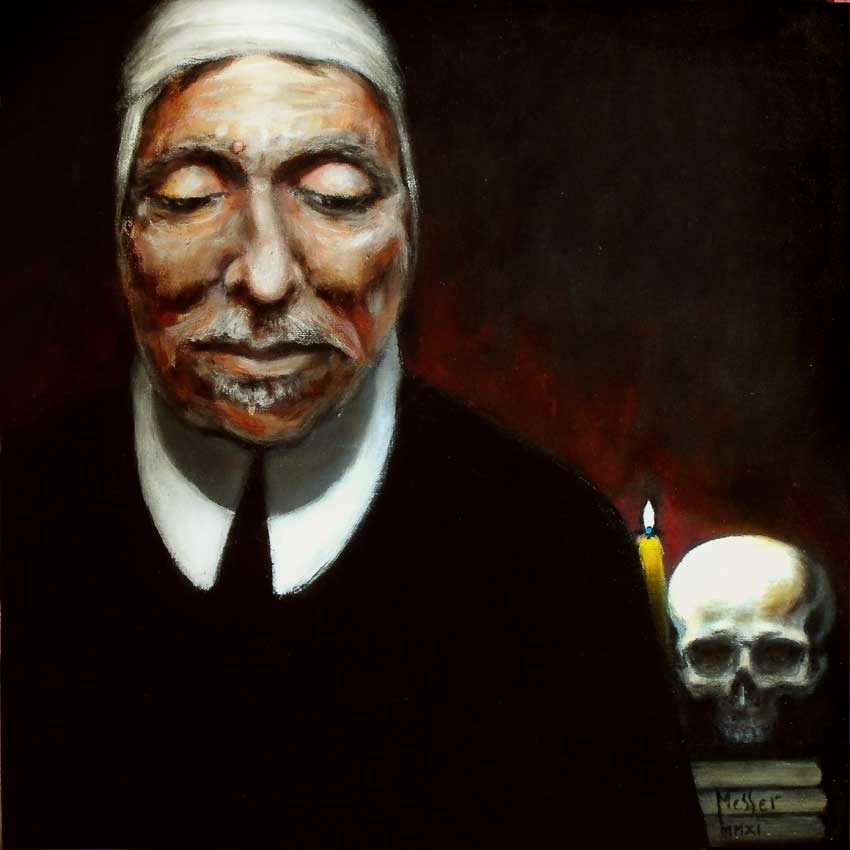
Oliver Cromwell's portrait: “Warts and all” (2011)


ZOOM image HERE.

Doing the portrait of a historical figure such as Oliver Cromwell requires having a sense of History.
This painting was submitted to Huntington's Cromwell's museum.

Who was Oliver Cromwell?

Oliver Cromwell (25 April 1599 – 3 September 1658) was an English military and political revolutionary leader best known in England for his overthrow of the monarchy and temporarily turning England into a republican Commonwealth.
His rise to power was a consequence of the English Civil War (1642–1651), a series of armed conflicts and political machinations between Parliamentarians (Roundheads) and Royalists (Cavaliers), partisans of King Charles I (1600 –1649).
After the first Civil War ended, Cromwell tried to negotiate a “limited monarchy” but Charles’s intrigue with the Scots and perfidy led to a second Civil War (1648–1649) which he lost. He was tried and beheaded. His son was exiled and English monarchy was replaced with first, the Commonwealth of England (1649–53), and then with a Protectorate (1653–59), under Cromwell's personal rule.

Controversy around Cromwell’s legacy: his head

When Charles’ I’s son, Charles II returned in 1660 to restore the English, Scottish and Irish monarchies, he demanded that Oliver Cromwell's body be exhumed, along with those of two others implicated in the execution of his father. The bodies were removed from Westminster Abbey on 26th January 1661, to be tried and found guilty of high treason as revenge against Cromwell’s treatment of Charles’s father.
Four days later, on the anniversary of the execution of Charles I they were dragged to Tyburn. After a macabre hanging from the gallows all day before being taken down and having the heads severed from the bodies. It took more than one blow to remove Cromwell's head. Their heads were placed on poles on Westminster Hall as a warning to others. Another Cromwell ‘s death mask was then made and copies sent to every town and city that had been most loyal to the monarchy.
Cromwell‘s embalmed head was so displayed for 25 years.
At some point soon after 1684 the head either fell or was taken down. There is a strong tradition that it was blown off in a gale, retrieved by a sentinel, and hidden for many years. There is some evidence that it was in a private museum in London as early as 1710. It later passed to its next owner one Samuel Russell an actor manager, who had the head by the early 1770's and tried to sell it to Cromwell's old Sidney Sussex college in Cambridge, but it was refused.
It seems his head was later sold many times until it came into the possession of the Wilkinson family from the nineteenth into the twentieth centuries. Canon Horace Wilkinson, agreed in the early 1930's to allow two scientists full access to the head. Their conclusion was that the head was that of Oliver Cromwell (Pearson and Morant study).
Following Canon Wilkinson’s death, a suitable home was sought for the head.
It was again offered to Sidney Sussex College in 1960 and accepted by the College Council. The head was finally re- buried almost 300 years after it had been dug up from Westminster Abbey. It now rests somewhere within the ante-chapel at the College, the precise spot unmarked to ensure that it is left in peace.

Controversy behind Cromwell’s first image: his wax death mask

Cromwell’s wax death mask
Cromwell’s “wax” death mask is probably the best-known death mask of English history.
It was originally owned by Sir Hans Sloane (1660-1753) whose collection contributed to the founding of the British Museum where it is still displayed.
When Cromwell died, his actual body was initially secretly interred in Westminster Abbey. But unknown then to those coming to mourn and before it began to putrefy, a wooden effigy of Cromwell with a wax mask that lay in state at Somerset House. The funeral effigy depicted Cromwell as a King, a title which he had refused in his lifetime.
The “wax” death mask of Oliver Cromwell was taken after the embalmment of his body and it shows the cloth bound around his head to cover the cincture.
I decided to keep it instead of a traditional puritan hat or helmet, adding I believe more modesty to his memory. This way also reminds me of Rembrandt van Rijn (1606–1669)‘s  self-portrait as “St Paul”.
Rembrandt van Rijn ‘s  self-portrait as “St Paul”.
Death masks were widely distributed through private and public collections and were also used as models for posthumous portraits. By using his to realize his portrait, I decided to keep this old tradition alive... as his opening eyes witness this.

“Warts and all”… a Dutch “Vanity”

Commissioning a portrait was at the time as still is, intended to flatter the sitter. Cromwell was well-known for being opposed to all forms of personal vanity.
The first record of that famous “Warts and all” phrase as being attributed to Cromwell’s comes from Horace Walpole's Anecdotes of Painting in England (1764). It is said to derive from Oliver Cromwell's instructions to his painter Sir Peter Lely, and was reported in a conversation between John Sheffield, Duke of Buckingham, and the house's architect, Captain William Winde. Winde claimed Cromwell saying that:

"Mr Lely, I desire you would use all your skill to paint my picture truly like me, and not flatter me at all; but remark all these roughnesses, pimples, warts and everything as you see me, otherwise I will never pay a farthing for it."

Following his posthumous instructions, I decided to paint his portrait as truthfully to his real appearance, not based on his portraitures. I therefore decided to paint him after his death mask, i.e. his most faithful image. His last image too.

I chose to do his portrait in manner of a Ducth Vanitas painting.
Vanitas is a type of still-life that became popular in Europe, particularly in the Netherlands during Cromwell’s time.
Vanitas by Pieter Claesz (1772)
The term “vanitas” comes from the Latin word meaning “emptiness”. The primary themes were impermanence, mortality, the meaninglessness of earthly life and delights when compared to the everlasting nature of faith. The idea comes from the Bible: "Vanity of Vanities, saith the preacher, all is vanity” (Ecclesiastes 12:8). Vanitas often have a human skull and a candle as a direct reference to man’s temporary existence on Earth.

I also thought that a 17th C Dutch style would be more appropriate than say Flemish Baroque painter Anthony Van Dyck’s (1599 –1641) who is most famous for his portraits of Cromwell’s enemy; King Charles I, his family and court.
Van Dyck was one of the most influential 17th-century painters in England. He set a new style for Flemish art and founded the English school of painting to be the dominant influence on English portrait-painting for the next 150 years. The portraitists Sir Joshua Reynolds and Thomas Gainsborough of that school were his artistic heirs.
But Van Dyck was born in the Southern Netherlands, a region recaptured from the Dutch Republic by Habsburg Spain (1581–1713). It is now called Belgium, a country where I come from.
To highlight the Dutch influence over Cromwell, I decided to paint him in the style of this Dutch contemporary painter Rembrandt van Rijn.
As an artist I am deeply influenced by his “light and shade” technique and painted using his style/technique for many years. Rembrandt was never about flattering his subjects and used to paint rough with thick paint.

Cromwell’s Dutch card?

When William II, Prince of Orange and head of the Dutch Republic died in 1650, it gave hopes to Cromwell that the Dutch Republic might join the Commonwealth in a military alliance against Spain.
Cromwell’s hopes may have also been supported by the contribution some Dutch did to the draining of the “Fens” from East Anglia to gain more land over the sea, a region he knew well as MP of Huntingdonshire and Isle of Ely (where I live now). Their draining was initiated by one Cornelius Vermuyden (1595 –1677) a Dutch engineer who introduced Dutch reclamation methods to Britain.

To this purpose, Cromwell sent in 1651 Oliver St John to The Hague in Holland as one of the envoys to negotiate a union between England and the Dutch Republic, a mission in which he entirely failed, leading to the First Anglo-Dutch War (1652-54).
However, Cromwell had another card up his sleeve; he also wanted to attract the rich Jews of Amsterdam to London so that they might transfer their important trade interests with Spain from Holland to England. Contacts were made with Amsterdam’s chief rabbi Menasseh Ben Israel, a client and friend of Rembrandt. Cromwell invited the rabbi to come over to London in September 1655, after the end of the Anglo-Dutch war, to negotiate the return of the Jews to England (expelled by King Edward I in 1290).
My Cromwell portrait is a kind of posthumous gratitude from the Jew I am.

Sources:


Saturday, 18 December 2010

Richard Feynman; the scientist and the artist.

"The adventure of our science of physics is a perpetual attempt to recognize that the different aspects of nature are really different aspects of the same thing." 
-- Richard Feynman


Richard Feynman (1918 –1988), one of the most brilliant theoretical physicists of this last century was also one of our greatest minds. Feynman was not just “another scientist”, he was a larger-than-life character.

Feynman was awarded the Nobel Prize for his work in Quantum electrodynamics (QED) in 1965, together with fellow American Julian Schwinger and Shinichiro Tomonaga of Japan, both of whom had separately developed similar theories, but using different mathematical methods.

Feynman's theory was especially distinct from the other two in its use of graphic models to describe the intermediate states that a changing electrodynamic system passes through. These models are known as "Feynman diagrams" and are widely used in many quantum-electrodynamic problems. Feynman was fond of using visual techniques to solve problems.
Feynman Diagram


Let’s draw Feynman diagrams!

In addition to his Feynman diagrams, he developed a method of analyzing MASER (microwave amplification by stimulated emission of radiation) devices that relies heavily on creating accurate pictorial representations of the interactions involved.

Freeman Dyson, one of the architects of modern QED had this to say about how Richard Feynman did his calculations:
"... Dick was using his own private quantum mechanics that nobody else could understand. They were getting the same answers whenever they calculated the same problem...The reason Dick's physics was so hard for ordinary people to grasp was that he did not use equations... Dick just wrote down the solutions out of his head without ever writing down the equations. He had a physical picture of the way things happen, and the pictures gave him the solutions directly with a minimum of calculation... It was no wonder that people who had spent their lives solving equations were baffled by him. Their minds were analytical; his was pictorial..."
From visualisations and mathematicians 

The artist-genius 

Feynman's innate "child-like” curiosity and creativity caused him to be “labelled” a “genius”.
“I've always been very one-sided about science, and when I was younger I concentrated almost my effort on it. In those days I didn't have the time, and I didn't have the patience, to learn what's called the humanities.”    
From John Gribbin and Mary Gribbin, Richard Feynman : A Life in Science (New York : Dutton, 1997) , p. 113.) 
This changed after his encounter with artist-painter Jirayr Zorthian. Feynman was extremely open to exploring new areas of inquiry beyond his world-famous expertise in science. Zorthian agreed to teach Feynman to draw, and Feynman agreed to teach Zorthian physics. He started drawing at the age of 44 in 1962, shortly after developing the visual language for his famous "Feynman diagrams," after a series of amicable arguments about "art vs. science" with his artist-friend Jirayr “Jerry” Zorthian — the same friend to whom Feynman’s timeless ode to a flower was in response.The scientific instruction did not continue long, but Zorthian’s influences on Feynman led to the physicist’s life-long involvement in art making.


But Is It Art?


In an introductory essay titled “But Is It Art?,” Feynman recounts his arrangement with Jerry and observes the intersection of art and science:
I wanted very much to learn to draw, for a reason that I kept to myself: I wanted to convey an emotion I have about the beauty of the world. It’s difficult to describe because it’s an emotion. It’s analogous to the feeling one has in religion that has to do with a god that controls everything in the universe: there’s a generality aspect that you feel when you think about how things that appear so different and behave so differently are all run ‘behind the scenes’ by the same organization, the same physical laws. It’s an appreciation of the mathematical beauty of nature, of how she works inside; a realization that the phenomena we see result from the complexity of the inner workings between atoms; a feeling of how dramatic and wonderful it is. It’s a feeling of awe — of scientific awe — which I felt could be communicated through a drawing to someone who had also had that emotion. I could remind him, for a moment, of this feeling about the glories of the universe.  
From The Art of Ofey: Richard Feynman’s Little-Known Sketches & Drawings
Jirayr Zorthian by Richard Feynman
More sketches and paintings by Richard Feynman here.

"Visualization - you keep repeating that", Feynman said to another historian, Silvan S. Schweber, who was trying to interview him.
Feynman: "What I am really try to do is bring birth to clarity, which is really a half-assedly thought-out-pictorial semi-vision thing. I would see the jiggle-jiggle-jiggle or the wiggle of the path. Even now when I talk about the influence functional, I see the coupling and I take this turn - like as if there was a big bag of stuff - and try to collect it in away and to push it.It's all visual. It's hard to explain." 
Schweber: "In some ways you see the answer - ?" 
Feynman: "The character of the answer, absolutely. An inspired method of picturing, I guess. Ordinarily I try to get the pictures clearer, but in the end the mathematics can take over and be more efficient in communicating the idea of the picture." "In certain particular problems that I have done it was necessary to continue the development of the picture as the method before the mathematics could be really done." 
Source : interview given by James Gleick from "The Life and Science of Richard Feynman", Vintage Books, New York, 1992, pgs 241-225.

See 2008 Exhibition: Jirayr Zorthian / Richard Feynman: A Conversation In Art


Further reading: The Art of Richard P. Feynman: Images by a Curious Character: Michelle Feynman, Albert Hibbs

Feynman was also a poet and an enthusiast bongo player!
Poem by Richard Feynman:

There are the rushing waves
mountains of molecules
each stupidly minding its own business
trillions apart
yet forming white surf in unison.
Ages on ages before any eyes could see
year after year
thunderously pounding the shore as now.
For whom, for what?
On a dead planet
with no life to entertain.
Never at rest
tortured by energy
wasted prodigiously by the sun
poured into space.
A mite makes the sea roar.
Deep in the sea
all molecules repeat
the patterns of one another
till complex new ones are formed.
They make others like themselves
and a new dance starts.
Growing in size and complexity
living things
masses of atoms
DNA, protein
dancing a pattern ever more intricate.
Out of the cradle
onto dry land
here it is
standing:
atoms with consciousness;
matter with curiosity.
Stands at the sea,
wonders at wondering: 
a universe of atoms
an atom in the universe.

Richard Feynman's blackboard at the time of his death: 
"WHAT I CANNOT CREATE, I DO NOT UNDERSTAND"


In my "2C Hall of Fame", Richard Feynman stands high.


Saturday, 7 August 2010

Portrait of Richard Feynman

Richard Feynman (1918 –1988), one of the most brilliant theoretical physicists of this last century was also one of our greatest minds.
In 1965 he received the Nobel Prize in Physics for his contributions to the development of quantum electrodynamics (QED), jointly with Julian Schwinger and Sin-Itiro Tomonaga. He developed a widely used visual representation for the mathematical expressions governing the behaviour of subatomic particles, which later became known as “Feynman diagrams”. Yet Feynman despised honours and “academic” authorities. He even considered refusing his Prize!

Feynman was not just “another scientist”, he was a larger-than-life character.
His contributions were not limited to science but were also artistic. He was indeed a good painter, a poet and an enthusiast bongo player!
His innate "child-like” curiosity and creativity caused him to be “labelled” a “genius”.
His personality was as summed up by General Donald Kutyna: "Feynman had three things going for him. Number one, tremendous intellect and that was well known around the world. Second, integrity…..Third, he brought this driving, desire to get to the bottom of any mystery. No matter where it took him, he was going to get there, and he was not deterred by any roadblocks in the way. He was a courageous guy, and he wasn't afraid to say what he meant."

Unlike Professor Steven Hawking, I couldn’t have had the chance to ever meet Richard Feynman. However his writings, his filmed interviews, his recorded lectures, his drawings, paintings and poems have survived. They were all created by the same mind and can reach us as if still alive.

Helped with pictures or videos available on the Internet, I tried to capture his colourful and engaging personality: intense, deep yet frivolous.

The background looks like the “chaos” of particles collisions. This is no accident. I used here a technique similar to a Jackson Pollock’s “dripping paint”. But unlike Pollock, I didn’t stop there.

In my portrait of Feynman, his body posture has a Y shape. This is my preferred letter. I believe this was his too.
Here is one of his poems:

I wonder why?
I wonder why?
I wonder why I wonder?
I wonder why I wonder why I wonder why I wonder?
(In "Surely you're joking, Mr. Feynman!")


"The Art of Richard P. Feynman". Compiled by Michelle Feynman.
More from my upcoming book "The eye inside" 


My portrait of Richard Feynman


Richard Feynman (1918 –1988), one of the most brilliant theoretical physicists of this last century was also one of our greatest minds.

Unlike Professor Steven Hawking, I couldn’t have had the chance to ever meet Richard Feynman. However his writings, his filmed interviews, his recorded lectures, his drawings, paintings and poems have survived. They were all created by the same mind and can reach us as if still alive.

Helped with pictures or videos available on the Internet, I tried to capture his colourful and engaging personality: intense, deep yet frivolous.

The background looks like the “chaos” of particles collisions. This is no accident. I used here a technique similar to a Jackson Pollock’s “dripping paint”. But unlike Pollock, I didn’t stop there.

In my portrait of Feynman, his body posture has a Y shape. This is my preferred letter. I believe this was his too.


Here is one of his poems: 

I wonder why?
I wonder why?
I wonder why I wonder?
I wonder why I wonder why I wonder why I wonder?
(In "Surely you're joking, Mr. Feynman!")

Tuesday, 27 July 2010

Homage to Vincent Van Gogh


Exactly 120 years ago, in July 27, 1890, Vincent Van Gogh walked out into the fields around Auvers-sur-Oise and shot himself in the chest with a revolver. He died two days later.
Yet, by all our criteria of "success", Van Gogh was a failure.
Before deciding to become an artist, he had had two unsuitable and unhappy romances and had worked unsuccessfully as a clerk in a bookstore, as an art salesman, and a preacher in Belgium. In 1886 he went to Paris to join his brother Théo, the manager of Goupil's gallery and to study Art. He encountered the Impressionists and began to lighten his very dark palette.
He decided to go south to Arles where he hoped his friends would join him and help found a school of art with Gauguin. A violent row started between the two which led to total disaster. After the row, Van Gogh ended up cutting a portion of his own ear lobe off, wrapped it in newspaper, and gave it to a prostitute named Rachel. In May of 1890, he was sent to the asylum in Saint-Remy for treatment where he met with Dr Gachet and where he painted "The Starry Night," one of his most famous paintings.
Some two months later he was dead, having shot himself "for the good of all."  He felt a burden to his brother’s family, and a failed artist.
The Red Vineyard
Van Gogh's finest works were produced during his three last years. He produced over 2,000 works and sold only one during his life: The Red Vineyard.
Although today, these paintings can fetch tens of millions of $ at auction and enrich many collectors, they were worthless during his lifetime. Nobody bought them. One day, he even begged for meat to his butcher against one of his paintings. The butcher refused his offer. 
History is cruel. His Doctor Gachet portrait was sold in auction for $82.5 million, an auction record. A Japanese industrialist multimillionaire Ryoei Saito bought it and took it to Tokyo, where he left it unseen by anyone for seven years. He joked about his wish to get the famous painting cremated with him. Since he died in 1995, nobody really knows who is the new owner of Dr. Gachet portrait or its location.

I have painted a portrait of Dr. Gachet with a melancholy expression, which might well seem like a grimace to those who see it. . . . Sad but gentle, yet clear and intelligent, that is how many portraits ought to be done. . . . There are modern heads that may be looked at for a long time, and that may perhaps be looked back on with longing a hundred years later.
VINCENT VAN GOGH, JUNE 1890


The best way to learn from a master like Van Gogh is to copy him. So did I and as homage, I chose for my painting’s quiet backdrop his Noon, or The Siesta, (after Millet, 1890). 
I used real gold paint instead of his so-called “Van Gogh’s yellows” to paint hays.
I believe had he the opportunity, he would have used it as he was a fond admirer of Asiatic and Japanese art.
Depending on the gold’s reflections and your angle's viewpoint, you will see Vincent’s dying and (logically)  colorless body to appear or disappear... 
I also found his brush technique very energetic yet easier and more natural than I thought (no wonder he painted so many pictures!). He clearly loved hays as it is natural for his brush strokes technique.
I also understood that when he was painting colors, they were not just “vibrating” but also very "material". Van Gogh was treating light and colours as he would have treated concrete matter, and vice-versa. In Van Gogh’s mind light was BOTH a wave (vibration) and a particle (matter). It was a sort of artist’s take on the “wave-particle” famous scientific paradox.

Epitaph:

The true artist is living on the edge of life, like walking a tightrope with no net.
He is admired for his incredible aerial feats, his freedom yet his admirers hope he will fall, he will fail. This is their thrill. This is why he is tapped on the back in hope one day he will.

Van Gogh fell but didn't fail.


Tuesday, 13 July 2010

My "Pillars of Creation"

 I am not a landscape painter but since the releases of the Hubble Space Telescope’s pictures, galaxies and other nebulae have become part of our landscape. The central subject of my painting is the "Pillars of Creation", located in The Eagle Nebula (M16, NGC 6611). Released in April 1995, they are Hubble Space Telescope’s most famous picture. The M16 is approximately 7,000 light years away and is approximately 24 trillion miles long.
My painting is a 360 degrees panorama which has therefore no fixed central viewpoint. It is however viewed from one single observer living on our planet Earth.
I have therefore painted it from all possible angles, turning the canvas on all its four possible positions (therefore these four views of my painting). This painting can be appreciated from any angle, hopefully superseding the limited "Cubist perspective" attempted a century ago.
As a so-called "fish-eye" panorama, its positive curvature reflects the curvature of our expanding (inflationary) universe.
The "Pillars" patterns can also be found amongst the clouds above the sun (sorry but my photograph isn't good enough to see them well). These are "Pillars-like clouds" BUT with quite literally a twist: they are inverted as in a mirror. My idea here is to suggest the idea of a relation between what Ancient philosophers called Macrocosm&Microcosm. In Ancient Egypt, our "Milky Way" was considered as a celestial copy of the "earthly Nile", a place where all dead's souls end their journey. 
I liked this metaphor: we are but a reflection of a much bigger world. We are mere stardust.
Viewed at some distance, the circle of the panorama can also be seen as either an outside or inside "sphere"- my artistic rendering of the concept of a "boundless yet finite" Universe.
I hope that at this point you feel a little bit dizzy... 
The circle of the panorama can also be seen as a clock. If you look a little bit closer you will realize it is being populated by Life's activities over a span of... several millions years. The central subject being, after all, the "Pillars of Creation". We are all ephemeral stardust, are we not?
So it is all about time + space ... in a nutshell.
The irony is that this image of these "Pillars of Creation" isn't eternal either. In 2007 an infrared image from the Spitzer Space Telescope revealed a previously unknown supernova whose shock wave may have destroyed the Pillars approximately 6,000 years ago. 
Given the distance to the nebula, we have another 1,000 years to enjoy this striking beauty.
Since I won't live long enough, I thought it would be a good idea to portray it.

This painting of Vincent Van Gogh (The Starry Night) was an obvious inspiration.


My "Pillars of Creation"

 I am not a landscape painter but since the releases of the Hubble Space Telescope’s pictures, galaxies and other nebulae have become part of our landscape. The central subject of my painting is the "Pillars of Creation", located in The Eagle Nebula (M16, NGC 6611). Released in April 1995, they are Hubble Space Telescope’s most famous picture. The M16 is approximately 7,000 light years away and is approximately 24 trillion miles long.
My painting is a 360 degrees panorama which has therefore no fixed central viewpoint. It is however viewed from one single observer living on our planet Earth.
I have therefore painted it from all possible angles, turning the canvas on all its four possible positions (therefore these four views of my painting). This painting can be appreciated from any angle, hopefully superseding the limited "Cubist perspective" attempted a century ago.
As a so-called "fish-eye" panorama, its positive curvature reflects the curvature of our expanding (inflationary) universe.
The "Pillars" patterns can also be found amongst the clouds above the sun (sorry but my photograph isn't good enough to see them well). These are "Pillars-like clouds" BUT with quite literally a twist: they are inverted as in a mirror. My idea here is to suggest the idea of a relation between what Ancient philosophers called Macrocosm&Microcosm. In Ancient Egypt, our "Milky Way" was considered as a celestial copy of the "earthly Nile", a place where all dead's souls end their journey. 
I liked this metaphor: we are but a reflection of a much bigger world. We are mere stardust.
Viewed at some distance, the circle of the panorama can also be seen as either an outside or inside "sphere"- my artistic rendering of the concept of a "boundless yet finite" Universe.
I hope that at this point you feel a little bit dizzy... 
The circle of the panorama can also be seen as a clock. If you look a little bit closer you will realize it is being populated by Life's activities over a span of... several millions years. The central subject being, after all, the "Pillars of Creation". We are all ephemeral stardust, are we not?
So it is all about time + space ... in a nutshell.
The irony is that this image of these "Pillars of Creation" isn't eternal either. In 2007 an infrared image from the Spitzer Space Telescope revealed a previously unknown supernova whose shock wave may have destroyed the Pillars approximately 6,000 years ago. 
Given the distance to the nebula, we have another 1,000 years to enjoy this striking beauty.
Since I won't live long enough, I thought it would be a good idea to portray it.

This painting of Vincent Van Gogh (The Starry Night) was an obvious inspiration.