Wednesday, 5 June 2013

3. "Pillars of Creation"

"Stardust" (150 x 150 cm - 2013) 
I started it in 2010 - but was unhappy with it. See my post then. 
Still using Hubble Space Telescope's photo "Pillars of Creation" the center of the Eagle nebula. The tower of gas that can be seen coming off the nebula is approximately 9.5 light-years or about 90 trillion kilometers high, depicting a large region of star formation. The view is a 360 degrees panorama, giving a sense of alleged "positive curvature" of our Universe.


This painting will be part of my upcoming exhibition on art + science "Two Cultures?".
Who are we? We find that we live on an insignificant planet of a humdrum star lost in a galaxy tucked away in some forgotten corner of a universe in which there are far more galaxies than people. – Carl Sagan 

Wednesday, 15 May 2013

Sunday, 8 April 2012

The Name of the Game


Artists' worth relies on fame and name, i.e. a signature. 
In today’s art market, such a name has become a brand. No matter how good or bad the artwork is, provided it is signed with a “recognized name”.  
For instance, the Spanish surrealist painter Salvador Dali gave away around 20,000 blank sheets of paper with his... signature, triggering a flood of forged Dali prints.
British journalist Mick Brown bore witness to one such scene. He was in Dali’s suite at the Ritz Hotel in Barcelona in the summer of 1973, he said, and watched the maestro churning through “a large pile of blank sheets of lithographic paper. As Dalí signed each sheet, his companion and muse, Amanda Lear, joked that ‘that’s another $100,000 Dalí has made this morning’...

That year, celebrated genius artist Orson Welles had these deep comments in his “F for Fake” film:
"Our works in stone, in paint, in print, are spared, some of them, for a few decades or a millennium or two, but everything must finally fall in war, or wear away into the ultimate and universal ash - the triumphs, the frauds, the treasures and the fakes. A fact of life: we're going to die. "Be of good heart," cry the dead artists out of the living past. "Our songs will all be silenced, but what of it? Go on singing." Maybe a man's name doesn't matter all that much."


We live in a society dominated by a cult of celebrities, where artists have become "brand-names" to sell... anything but their own art. People are "famous", not thanks to their talent, but because they are "famous"... This hasn't always been the case...
With film extracts from "F for fake" (by Orson Welles), "The name of the rose" directed by Jean-Jacques Annaud, based on the book of the same name by Umberto Eco. Music "Fame" by David Bowie.

Richard Feynman: "What's the name of a bird?"

Saturday, 14 January 2012

Happy 70th, Professor Stephen Hawking and Thank You! ;-)

Portrait of Stephen Hawking: "Wink to Life". Technique: mixed (oil, acrylic, crayon, etc) on canvas. Size: approx. 66 x 66 cm Date: 2012
Dear Professor Stephen Hawking. I wish to thank you.
Thank you for your determination and stubbornness in life which is an inspiration to us all. I received your message addressed today quite well: "Be curious" (I am) and "Don't give up!" (I won't). This is why I decided to paint this second portrait of yours after this first one (end of 2009) after we met the year before.

Mr. Hawking, your MND (Motor Neurone Disease) limits you immensely. It allows you now to use only the right-hand side of your face. Ironically, this physical handicap permits you to "wink" to us and to this Universe. A wink to “fate”. Hence your portrait and its title.  ;-)

Creativity is a very complex and “uncertain” activity. I tried then many different solutions/ compositions to convey both your personality and the scientific issues and challenges that have occupied your entire life.

I destroyed this painting of mine.
I eventually destroyed these first compositions  but decided to come back to one of them with a new approach based on my current research regarding C.P. Snow’s “Two Cultures” question : what is apparently dividing Arts (Humanities) and Sciences and why such dichotomy? Are these disciplines irreconcilable?

Cosmology is also divided by dichotomies; the principles of quantum mechanics and the laws of general relativity (GR) of our known Universe are apparently (mathematically) irreconcilable theories, which Professor Hawking tries to solve.

The background of my 2012 portrait of Professor Hawking is an attempt to illustrate this: I decided to "superpose" patterns from particle collisions against patterns from nebulae/ galaxies. Prof. Hawking's face (mind) then appears as a possible "bridge" between these two perspectives (relativistic and quantic). We humans stand between the very large and the very small scales. 

WINKS!...
There are many winks in this portrait. Besides Professor Hawking's, there are both artistic and scientific winks too.

The background is incomplete on its left-hand side... on purpose. It refers to the so-called "theory of everything" (TOE) which Professor Hawking and his colleagues are working on for decades. At the forefront I painted what particles collisions look like when smashed into smaller pieces. The process appear very "random" and "chaotic"and I used dripping techniques from Jackson Pollock's. Although "chaotic" the particle collisions follow some patterns (straight lines or spirals) which our eyes /mind can recognize... Behind this, I painted nebulae/ galaxies which obey to Einstein's GR laws of gravity. These two "perspectives", the infinitely small (quantic level) and the infinitely large are superposed, trying to visually express this mystery.

Doing so I hope to contribute to solve another dichotomy: that between Arts (Humanities) and Sciences.

Professor Hawking's "wink" is pointing both at this TOE and Life itself.;-)


Notes: 

  1. A few weeks after my 2012 portrait of Professor Hawking, David Hockney was invited to do his portrait of Professor Hawking to celebrate his 70th birthday. It is now part of the Science museum exhibit. I have no idea how it looks like, it seems shown nowhere.
  2. I also submitted my portrait at this year 2012 BP award of the National Portrait Gallery (NPG). This was the other reason why I finished it in January 2012 (Professor Hawking's birthday is on January 8, 1942). Why NPG? To give its curators and director an opportunity to redeem themselves after having  commissioned Professor Hawking's portrait in 1985 to Yolanda Sonnabend who delivered a very poor portrait. When visiting NPG, this portrait became my motivation for contacting Professor Hawking in 2008, and to learn we shared the same views on this poor portrait by Sonnabend. The 2012 BP award rejected my submission.

Sunday, 8 January 2012

Happy 70th, Professor Stephen Hawking and Thank You! "Wink to Life"... ;-)

Portrait of Stephen Hawking: "Wink to Life". Technique: mixed (oil, acrylic, crayon, etc) on canvas. Size: approx. 66 x 66 cm
Dear Professor Stephen Hawking. I wish to thank you.
Thank you for your determination and stubbornness in life which is an inspiration to us all. I received your message addressed today quite well: "Be curious"(I am) and "Don't give up!" (I won't). This is why I decided to paint this second portrait of yours after this first one (end of 2009) after we met the year before.

Creativity is a very complex and “uncertain” activity. I tried then many different solutions/ compositions to convey both your personality and the scientific issues and challenges that have occupied your entire life.
I eventually destroyed these first compositions (see right-hand side picture) but decided to come back to one of them with a new approach based on my current research regarding C.P. Snow’s “Two Cultures” question : what is apparently dividing Arts and sciences and why so?
This portrait's background is an attempt to illustrate this crucial paradox (yet real) between two theories; the quantic and the relativistic laws of our Universe. I decided to "superpose" patterns from particle collisions against patterns from nebulae/ galaxies, … with us humans, the very complex ones, in between the very large and the very small scales. You are standing where “human complexity” does.

We know that your MND (Motor Neurone Disease) limits you immensely. It allows you now to use only the right-hand side of your face. Ironically, this physical handicap permits you to "wink" to us and to this Universe. A wink to “fate”. Hence your portrait. ;-)

My comments:
WINKS!...
There are many winks in this portrait. Besides Professor Hawking's, there are both artistic and scientific winks too.
The background is incomplete on its left-hand side... on purpose. It "symbolizes" the so-called "theory of everything" (TOE) which Professor Hawking and his colleagues are working on for decades. At the forefront I painted what particles collisions look like when smashed into smaller pieces. The process appear very "random" and "chaotic"and I used dripping techniques from Jackson Pollock's. Although "chaotic" the particle collisions follow sometimes very geometric mathematical paths (straight lines or spirals)... Behind this, I painted nebulae/ galaxies which obey to Einstein's General relativity laws of gravity. These two "levels", the infinitely small (quantum level) and infinitely large are placed as in "perspective", trying to visually reconcile two seemingly irreconcilable theories, towards a so-called "TOE"...
Professor Hawking's "wink" is pointing both at this TOE and to Life itself.;-)

Notes: 

  1. A few weeks after my 2012 portrait, David Hockney was invited to do his portrait of Professor Hawking to celebrate his 70th birthday. It is now part of the Science museum exhibit.
  2. I also submitted my portrait at this year 2012 BP award of the National Portrait Gallery (NPG). This was the second reason why I finished it this January (the first being Professor Hawking's birthday). Why NPG? To give its curators and director an opportunity to redeem themselves after having  commissioned Professor Hawking's portrait in 1985 to Yolanda Sonnabend who delivered a very poor portrait. When visiting NPG, this portrait became my motivation for contacting him in 2008, and to learn we shared the same views on this poor portrait by Sonnabend. The 2012 BP award rejected my submission.

Tuesday, 19 April 2011

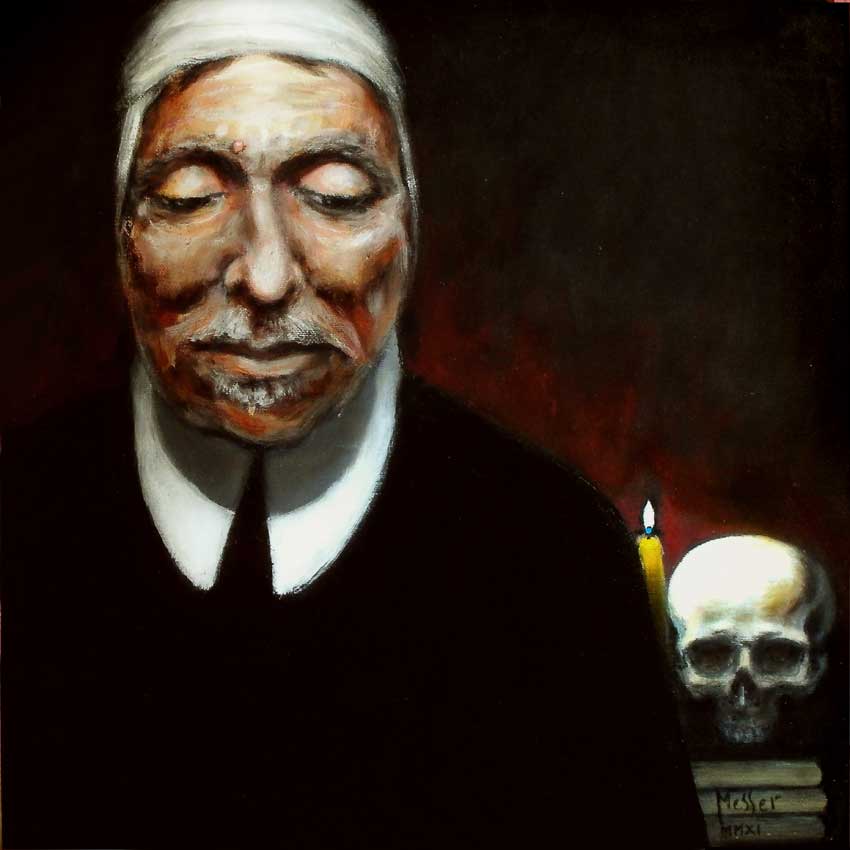
Oliver Cromwell's portrait: “Warts and all” (2011)


ZOOM image HERE.

Doing the portrait of a historical figure such as Oliver Cromwell requires having a sense of History.
This painting was submitted to Huntington's Cromwell's museum.

Who was Oliver Cromwell?

Oliver Cromwell (25 April 1599 – 3 September 1658) was an English military and political revolutionary leader best known in England for his overthrow of the monarchy and temporarily turning England into a republican Commonwealth.
His rise to power was a consequence of the English Civil War (1642–1651), a series of armed conflicts and political machinations between Parliamentarians (Roundheads) and Royalists (Cavaliers), partisans of King Charles I (1600 –1649).
After the first Civil War ended, Cromwell tried to negotiate a “limited monarchy” but Charles’s intrigue with the Scots and perfidy led to a second Civil War (1648–1649) which he lost. He was tried and beheaded. His son was exiled and English monarchy was replaced with first, the Commonwealth of England (1649–53), and then with a Protectorate (1653–59), under Cromwell's personal rule.

Controversy around Cromwell’s legacy: his head

When Charles’ I’s son, Charles II returned in 1660 to restore the English, Scottish and Irish monarchies, he demanded that Oliver Cromwell's body be exhumed, along with those of two others implicated in the execution of his father. The bodies were removed from Westminster Abbey on 26th January 1661, to be tried and found guilty of high treason as revenge against Cromwell’s treatment of Charles’s father.
Four days later, on the anniversary of the execution of Charles I they were dragged to Tyburn. After a macabre hanging from the gallows all day before being taken down and having the heads severed from the bodies. It took more than one blow to remove Cromwell's head. Their heads were placed on poles on Westminster Hall as a warning to others. Another Cromwell ‘s death mask was then made and copies sent to every town and city that had been most loyal to the monarchy.
Cromwell‘s embalmed head was so displayed for 25 years.
At some point soon after 1684 the head either fell or was taken down. There is a strong tradition that it was blown off in a gale, retrieved by a sentinel, and hidden for many years. There is some evidence that it was in a private museum in London as early as 1710. It later passed to its next owner one Samuel Russell an actor manager, who had the head by the early 1770's and tried to sell it to Cromwell's old Sidney Sussex college in Cambridge, but it was refused.
It seems his head was later sold many times until it came into the possession of the Wilkinson family from the nineteenth into the twentieth centuries. Canon Horace Wilkinson, agreed in the early 1930's to allow two scientists full access to the head. Their conclusion was that the head was that of Oliver Cromwell (Pearson and Morant study).
Following Canon Wilkinson’s death, a suitable home was sought for the head.
It was again offered to Sidney Sussex College in 1960 and accepted by the College Council. The head was finally re- buried almost 300 years after it had been dug up from Westminster Abbey. It now rests somewhere within the ante-chapel at the College, the precise spot unmarked to ensure that it is left in peace.

Controversy behind Cromwell’s first image: his wax death mask

Cromwell’s wax death mask
Cromwell’s “wax” death mask is probably the best-known death mask of English history.
It was originally owned by Sir Hans Sloane (1660-1753) whose collection contributed to the founding of the British Museum where it is still displayed.
When Cromwell died, his actual body was initially secretly interred in Westminster Abbey. But unknown then to those coming to mourn and before it began to putrefy, a wooden effigy of Cromwell with a wax mask that lay in state at Somerset House. The funeral effigy depicted Cromwell as a King, a title which he had refused in his lifetime.
The “wax” death mask of Oliver Cromwell was taken after the embalmment of his body and it shows the cloth bound around his head to cover the cincture.
I decided to keep it instead of a traditional puritan hat or helmet, adding I believe more modesty to his memory. This way also reminds me of Rembrandt van Rijn (1606–1669)‘s  self-portrait as “St Paul”.
Rembrandt van Rijn ‘s  self-portrait as “St Paul”.
Death masks were widely distributed through private and public collections and were also used as models for posthumous portraits. By using his to realize his portrait, I decided to keep this old tradition alive... as his opening eyes witness this.

“Warts and all”… a Dutch “Vanity”

Commissioning a portrait was at the time as still is, intended to flatter the sitter. Cromwell was well-known for being opposed to all forms of personal vanity.
The first record of that famous “Warts and all” phrase as being attributed to Cromwell’s comes from Horace Walpole's Anecdotes of Painting in England (1764). It is said to derive from Oliver Cromwell's instructions to his painter Sir Peter Lely, and was reported in a conversation between John Sheffield, Duke of Buckingham, and the house's architect, Captain William Winde. Winde claimed Cromwell saying that:

"Mr Lely, I desire you would use all your skill to paint my picture truly like me, and not flatter me at all; but remark all these roughnesses, pimples, warts and everything as you see me, otherwise I will never pay a farthing for it."

Following his posthumous instructions, I decided to paint his portrait as truthfully to his real appearance, not based on his portraitures. I therefore decided to paint him after his death mask, i.e. his most faithful image. His last image too.

I chose to do his portrait in manner of a Ducth Vanitas painting.
Vanitas is a type of still-life that became popular in Europe, particularly in the Netherlands during Cromwell’s time.
Vanitas by Pieter Claesz (1772)
The term “vanitas” comes from the Latin word meaning “emptiness”. The primary themes were impermanence, mortality, the meaninglessness of earthly life and delights when compared to the everlasting nature of faith. The idea comes from the Bible: "Vanity of Vanities, saith the preacher, all is vanity” (Ecclesiastes 12:8). Vanitas often have a human skull and a candle as a direct reference to man’s temporary existence on Earth.

I also thought that a 17th C Dutch style would be more appropriate than say Flemish Baroque painter Anthony Van Dyck’s (1599 –1641) who is most famous for his portraits of Cromwell’s enemy; King Charles I, his family and court.
Van Dyck was one of the most influential 17th-century painters in England. He set a new style for Flemish art and founded the English school of painting to be the dominant influence on English portrait-painting for the next 150 years. The portraitists Sir Joshua Reynolds and Thomas Gainsborough of that school were his artistic heirs.
But Van Dyck was born in the Southern Netherlands, a region recaptured from the Dutch Republic by Habsburg Spain (1581–1713). It is now called Belgium, a country where I come from.
To highlight the Dutch influence over Cromwell, I decided to paint him in the style of this Dutch contemporary painter Rembrandt van Rijn.
As an artist I am deeply influenced by his “light and shade” technique and painted using his style/technique for many years. Rembrandt was never about flattering his subjects and used to paint rough with thick paint.

Cromwell’s Dutch card?

When William II, Prince of Orange and head of the Dutch Republic died in 1650, it gave hopes to Cromwell that the Dutch Republic might join the Commonwealth in a military alliance against Spain.
Cromwell’s hopes may have also been supported by the contribution some Dutch did to the draining of the “Fens” from East Anglia to gain more land over the sea, a region he knew well as MP of Huntingdonshire and Isle of Ely (where I live now). Their draining was initiated by one Cornelius Vermuyden (1595 –1677) a Dutch engineer who introduced Dutch reclamation methods to Britain.

To this purpose, Cromwell sent in 1651 Oliver St John to The Hague in Holland as one of the envoys to negotiate a union between England and the Dutch Republic, a mission in which he entirely failed, leading to the First Anglo-Dutch War (1652-54).
However, Cromwell had another card up his sleeve; he also wanted to attract the rich Jews of Amsterdam to London so that they might transfer their important trade interests with Spain from Holland to England. Contacts were made with Amsterdam’s chief rabbi Menasseh Ben Israel, a client and friend of Rembrandt. Cromwell invited the rabbi to come over to London in September 1655, after the end of the Anglo-Dutch war, to negotiate the return of the Jews to England (expelled by King Edward I in 1290).
My Cromwell portrait is a kind of posthumous gratitude from the Jew I am.

Sources: