Sunday, 22 January 2012

Saturday, 14 January 2012
Happy 70th, Professor Stephen Hawking and Thank You! ;-)
 |
| Portrait of Stephen Hawking: "Wink to Life". Technique: mixed (oil, acrylic, crayon, etc) on canvas. Size: approx. 66 x 66 cm Date: 2012 |
Thank you for your determination and stubbornness in life which is an inspiration to us all. I received your message addressed today quite well: "Be curious" (I am) and "Don't give up!" (I won't). This is why I decided to paint this second portrait of yours after this first one (end of 2009) after we met the year before.
Mr. Hawking, your MND (Motor Neurone Disease) limits you immensely. It allows you now to use only the right-hand side of your face. Ironically, this physical handicap permits you to "wink" to us and to this Universe. A wink to “fate”. Hence your portrait and its title. ;-)
Mr. Hawking, your MND (Motor Neurone Disease) limits you immensely. It allows you now to use only the right-hand side of your face. Ironically, this physical handicap permits you to "wink" to us and to this Universe. A wink to “fate”. Hence your portrait and its title. ;-)
Creativity is a very complex and “uncertain” activity. I tried then many different solutions/ compositions to convey both your personality and the scientific issues and challenges that have occupied your entire life.
 |
| I destroyed this painting of mine. |
Cosmology is also divided by dichotomies; the principles of quantum mechanics and the laws of general relativity (GR) of our known Universe are apparently (mathematically) irreconcilable theories, which Professor Hawking tries to solve.
The background of my 2012 portrait of Professor Hawking is an attempt to illustrate this: I decided to "superpose" patterns from particle collisions against patterns from nebulae/ galaxies. Prof. Hawking's face (mind) then appears as a possible "bridge" between these two perspectives (relativistic and quantic). We humans stand between the very large and the very small scales.
WINKS!...
There are many winks in this portrait. Besides Professor Hawking's, there are both artistic and scientific winks too.
The background is incomplete on its left-hand side... on purpose. It refers to the so-called "theory of everything" (TOE) which Professor Hawking and his colleagues are working on for decades. At the forefront I painted what particles collisions look like when smashed into smaller pieces. The process appear very "random" and "chaotic"and I used dripping techniques from Jackson Pollock's. Although "chaotic" the particle collisions follow some patterns (straight lines or spirals) which our eyes /mind can recognize... Behind this, I painted nebulae/ galaxies which obey to Einstein's GR laws of gravity. These two "perspectives", the infinitely small (quantic level) and the infinitely large are superposed, trying to visually express this mystery.
Doing so I hope to contribute to solve another dichotomy: that between Arts (Humanities) and Sciences.
Professor Hawking's "wink" is pointing both at this TOE and Life itself.;-)
Notes:
- A few weeks after my 2012 portrait of Professor Hawking, David Hockney was invited to do his portrait of Professor Hawking to celebrate his 70th birthday. It is now part of the Science museum exhibit. I have no idea how it looks like, it seems shown nowhere.
- I also submitted my portrait at this year 2012 BP award of the National Portrait Gallery (NPG). This was the other reason why I finished it in January 2012 (Professor Hawking's birthday is on January 8, 1942). Why NPG? To give its curators and director an opportunity to redeem themselves after having commissioned Professor Hawking's portrait in 1985 to Yolanda Sonnabend who delivered a very poor portrait. When visiting NPG, this portrait became my motivation for contacting Professor Hawking in 2008, and to learn we shared the same views on this poor portrait by Sonnabend. The 2012 BP award rejected my submission.
Sunday, 8 January 2012
Happy 70th, Professor Stephen Hawking and Thank You! "Wink to Life"... ;-)
|
| Portrait of Stephen Hawking: "Wink to Life". Technique: mixed (oil, acrylic, crayon, etc) on canvas. Size: approx. 66 x 66 cm |
Dear Professor Stephen Hawking. I wish to thank you.
Thank you for your determination and stubbornness in life which is an inspiration to us all. I received your message addressed today quite well: "Be curious"(I am) and "Don't give up!" (I won't). This is why I decided to paint this second portrait of yours after this first one (end of 2009) after we met the year before.
Creativity is a very complex and “uncertain” activity. I tried then many different solutions/ compositions to convey both your personality and the scientific issues and challenges that have occupied your entire life.
Creativity is a very complex and “uncertain” activity. I tried then many different solutions/ compositions to convey both your personality and the scientific issues and challenges that have occupied your entire life.I eventually destroyed these first compositions (see right-hand side picture) but decided to come back to one of them with a new approach based on my current research regarding C.P. Snow’s “Two Cultures” question : what is apparently dividing Arts and sciences and why so?
This portrait's background is an attempt to illustrate this crucial paradox (yet real) between two theories; the quantic and the relativistic laws of our Universe. I decided to "superpose" patterns from particle collisions against patterns from nebulae/ galaxies, … with us humans, the very complex ones, in between the very large and the very small scales. You are standing where “human complexity” does.
We know that your MND (Motor Neurone Disease) limits you immensely. It allows you now to use only the right-hand side of your face. Ironically, this physical handicap permits you to "wink" to us and to this Universe. A wink to “fate”. Hence your portrait. ;-)
My comments:
WINKS!...
There are many winks in this portrait. Besides Professor Hawking's, there are both artistic and scientific winks too.
The background is incomplete on its left-hand side... on purpose. It "symbolizes" the so-called "theory of everything" (TOE) which Professor Hawking and his colleagues are working on for decades. At the forefront I painted what particles collisions look like when smashed into smaller pieces. The process appear very "random" and "chaotic"and I used dripping techniques from Jackson Pollock's. Although "chaotic" the particle collisions follow sometimes very geometric mathematical paths (straight lines or spirals)... Behind this, I painted nebulae/ galaxies which obey to Einstein's General relativity laws of gravity. These two "levels", the infinitely small (quantum level) and infinitely large are placed as in "perspective", trying to visually reconcile two seemingly irreconcilable theories, towards a so-called "TOE"...
Professor Hawking's "wink" is pointing both at this TOE and to Life itself.;-)
WINKS!...
There are many winks in this portrait. Besides Professor Hawking's, there are both artistic and scientific winks too.
The background is incomplete on its left-hand side... on purpose. It "symbolizes" the so-called "theory of everything" (TOE) which Professor Hawking and his colleagues are working on for decades. At the forefront I painted what particles collisions look like when smashed into smaller pieces. The process appear very "random" and "chaotic"and I used dripping techniques from Jackson Pollock's. Although "chaotic" the particle collisions follow sometimes very geometric mathematical paths (straight lines or spirals)... Behind this, I painted nebulae/ galaxies which obey to Einstein's General relativity laws of gravity. These two "levels", the infinitely small (quantum level) and infinitely large are placed as in "perspective", trying to visually reconcile two seemingly irreconcilable theories, towards a so-called "TOE"...
Professor Hawking's "wink" is pointing both at this TOE and to Life itself.;-)
Notes:
- A few weeks after my 2012 portrait, David Hockney was invited to do his portrait of Professor Hawking to celebrate his 70th birthday. It is now part of the Science museum exhibit.
- I also submitted my portrait at this year 2012 BP award of the National Portrait Gallery (NPG). This was the second reason why I finished it this January (the first being Professor Hawking's birthday). Why NPG? To give its curators and director an opportunity to redeem themselves after having commissioned Professor Hawking's portrait in 1985 to Yolanda Sonnabend who delivered a very poor portrait. When visiting NPG, this portrait became my motivation for contacting him in 2008, and to learn we shared the same views on this poor portrait by Sonnabend. The 2012 BP award rejected my submission.
Tuesday, 19 April 2011
Oliver Cromwell's portrait: “Warts and all” (2011)
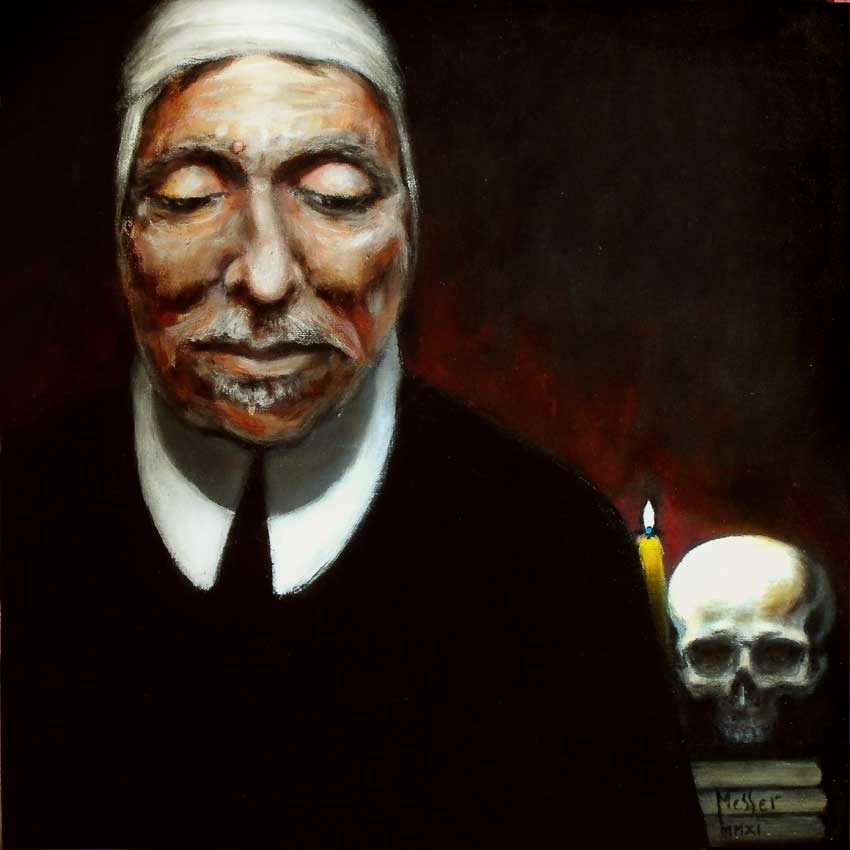
ZOOM image HERE.
Doing the portrait of a historical figure such as Oliver Cromwell requires having a sense of History.
This painting was submitted to Huntington's Cromwell's museum.
Doing the portrait of a historical figure such as Oliver Cromwell requires having a sense of History.
This painting was submitted to Huntington's Cromwell's museum.
Who was Oliver Cromwell?
Oliver Cromwell (25 April 1599 – 3 September 1658 ) was an English military and political revolutionary leader best known in England England
His rise to power was a consequence of the English Civil War (1642–1651), a series of armed conflicts and political machinations between Parliamentarians (Roundheads) and Royalists (Cavaliers), partisans of King Charles I (1600 –1649).
After the first Civil War ended, Cromwell tried to negotiate a “limited monarchy” but Charles’s intrigue with the Scots and perfidy led to a second Civil War (1648–1649) which he lost. He was tried and beheaded. His son was exiled and English monarchy was replaced with first, the Commonwealth of England
Controversy around Cromwell’s legacy: his head
When Charles’ I’s son, Charles II returned in 1660 to restore the English, Scottish and Irish monarchies, he demanded that Oliver Cromwell's body be exhumed, along with those of two others implicated in the execution of his father. The bodies were removed from Westminster Abbey on 26th January 1661 , to be tried and found guilty of high treason as revenge against Cromwell’s treatment of Charles’s father.
Four days later, on the anniversary of the execution of Charles I they were dragged to Tyburn. After a macabre hanging from the gallows all day before being taken down and having the heads severed from the bodies. It took more than one blow to remove Cromwell's head. Their heads were placed on poles on Westminster Hall as a warning to others. Another Cromwell ‘s death mask was then made and copies sent to every town and city that had been most loyal to the monarchy.
Cromwell‘s embalmed head was so displayed for 25 years.
At some point soon after 1684 the head either fell or was taken down. There is a strong tradition that it was blown off in a gale, retrieved by a sentinel, and hidden for many years. There is some evidence that it was in a private museum in London
It seems his head was later sold many times until it came into the possession of the Wilkinson family from the nineteenth into the twentieth centuries. Canon Horace Wilkinson, agreed in the early 1930's to allow two scientists full access to the head. Their conclusion was that the head was that of Oliver Cromwell (Pearson and Morant study).
Following Canon Wilkinson’s death, a suitable home was sought for the head.
It was again offered to Sidney Sussex College
Controversy behind Cromwell’s first image: his wax death mask
 |
| Cromwell’s wax death mask |
Cromwell’s “wax” death mask is probably the best-known death mask of English history.
It was originally owned by Sir Hans Sloane (1660-1753) whose collection contributed to the founding of the British Museum
When Cromwell died, his actual body was initially secretly interred in Westminster Abbey. But unknown then to those coming to mourn and before it began to putrefy, a wooden effigy of Cromwell with a wax mask that lay in state at Somerset House. The funeral effigy depicted Cromwell as a King, a title which he had refused in his lifetime.
The “wax” death mask of Oliver Cromwell was taken after the embalmment of his body and it shows the cloth bound around his head to cover the cincture.
I decided to keep it instead of a traditional puritan hat or helmet, adding I believe more modesty to his memory. This way also reminds me of Rembrandt van Rijn (1606–1669)‘s self-portrait as “St Paul”.
 |
| Rembrandt van Rijn ‘s self-portrait as “St Paul”. |
Death masks were widely distributed through private and public collections and were also used as models for posthumous portraits. By using his to realize his portrait, I decided to keep this old tradition alive... as his opening eyes witness this.
“Warts and all”… a Dutch “Vanity”
Commissioning a portrait was at the time as still is, intended to flatter the sitter. Cromwell was well-known for being opposed to all forms of personal vanity.
The first record of that famous “Warts and all” phrase as being attributed to Cromwell’s comes from Horace Walpole's Anecdotes of Painting in England (1764). It is said to derive from Oliver Cromwell's instructions to his painter Sir Peter Lely, and was reported in a conversation between John Sheffield, Duke of Buckingham, and the house's architect, Captain William Winde. Winde claimed Cromwell saying that:
"Mr Lely, I desire you would use all your skill to paint my picture truly like me, and not flatter me at all; but remark all these roughnesses, pimples, warts and everything as you see me, otherwise I will never pay a farthing for it."
Following his posthumous instructions, I decided to paint his portrait as truthfully to his real appearance, not based on his portraitures. I therefore decided to paint him after his death mask, i.e. his most faithful image. His last image too.
I chose to do his portrait in manner of a Ducth Vanitas painting.
Vanitas is a type of still-life that became popular in Europe , particularly in the Netherlands
 |
| Vanitas by Pieter Claesz (1772) |
The term “vanitas” comes from the Latin word meaning “emptiness”. The primary themes were impermanence, mortality, the meaninglessness of earthly life and delights when compared to the everlasting nature of faith. The idea comes from the Bible: "Vanity of Vanities, saith the preacher, all is vanity” (Ecclesiastes 12:8). Vanitas often have a human skull and a candle as a direct reference to man’s temporary existence on Earth.
I also thought that a 17th C Dutch style would be more appropriate than say Flemish Baroque painter Anthony Van Dyck’s (1599 –1641) who is most famous for his portraits of Cromwell’s enemy; King Charles I, his family and court.
Van Dyck was one of the most influential 17th-century painters in England
But Van Dyck was born in the Southern Netherlands , a region recaptured from the Dutch Republic Spain Belgium
To highlight the Dutch influence over Cromwell, I decided to paint him in the style of this Dutch contemporary painter Rembrandt van Rijn.
As an artist I am deeply influenced by his “light and shade” technique and painted using his style/technique for many years. Rembrandt was never about flattering his subjects and used to paint rough with thick paint.
Cromwell’s Dutch card?
When William II, Prince of Orange and head of the Dutch Republic Dutch Republic Spain
 Cromwell’s hopes may have also been supported by the contribution some Dutch did to the draining of the “
To this purpose, Cromwell sent in 1651 Oliver St The Hague Holland England Dutch Republic
However, Cromwell had another card up his sleeve; he also wanted to attract the rich Jews of Amsterdam to London Spain Holland England Amsterdam London England
My Cromwell portrait is a kind of posthumous gratitude from the Jew I am.
Sources:
My Cromwell portrait is a kind of posthumous gratitude from the Jew I am.
Sources:
- Cromwell's Head and its Curious History (Facebook)
- Oliver Cromwell's death mask for sale
- Wax death mask of Oliver Cromwell
- The last words of Oliver Cromwell
- Oliver Cromwell (Wikipedia)
Saturday, 18 December 2010
Richard Feynman; the scientist and the artist.
"The adventure of our science of physics is a perpetual attempt to recognize that the different aspects of nature are really different aspects of the same thing."
-- Richard Feynman
 |
Who was Richard Feynman?
Richard Feynman (1918 –1988), one of the most brilliant theoretical physicists of this last century was also one of our greatest minds. Feynman was not just “another scientist”, he was a larger-than-life character.
Feynman was awarded the Nobel Prize for his work in Quantum electrodynamics (QED) in 1965, together with fellow American Julian Schwinger and Shinichiro Tomonaga of Japan, both of whom had separately developed similar theories, but using different mathematical methods.
Feynman's theory was especially distinct from the other two in its use of graphic models to describe the intermediate states that a changing electrodynamic system passes through. These models are known as "Feynman diagrams" and are widely used in many quantum-electrodynamic problems. Feynman was fond of using visual techniques to solve problems.
 |
| Feynman Diagram |
Let’s draw Feynman diagrams!
In addition to his Feynman diagrams, he developed a method of analyzing MASER (microwave amplification by stimulated emission of radiation) devices that relies heavily on creating accurate pictorial representations of the interactions involved.
Freeman Dyson, one of the architects of modern QED had this to say about how Richard Feynman did his calculations:
"... Dick was using his own private quantum mechanics that nobody else could understand. They were getting the same answers whenever they calculated the same problem...The reason Dick's physics was so hard for ordinary people to grasp was that he did not use equations... Dick just wrote down the solutions out of his head without ever writing down the equations. He had a physical picture of the way things happen, and the pictures gave him the solutions directly with a minimum of calculation... It was no wonder that people who had spent their lives solving equations were baffled by him. Their minds were analytical; his was pictorial..."
From visualisations and mathematicians
The artist-genius
Feynman's innate "child-like” curiosity and creativity caused him to be “labelled” a “genius”.“I've always been very one-sided about science, and when I was younger I concentrated almost my effort on it. In those days I didn't have the time, and I didn't have the patience, to learn what's called the humanities.”
From John Gribbin and Mary Gribbin, Richard Feynman : A Life in Science (New York : Dutton, 1997) , p. 113.)This changed after his encounter with artist-painter Jirayr Zorthian. Feynman was extremely open to exploring new areas of inquiry beyond his world-famous expertise in science. Zorthian agreed to teach Feynman to draw, and Feynman agreed to teach Zorthian physics. He started drawing at the age of 44 in 1962, shortly after developing the visual language for his famous "Feynman diagrams," after a series of amicable arguments about "art vs. science" with his artist-friend Jirayr “Jerry” Zorthian — the same friend to whom Feynman’s timeless ode to a flower was in response.The scientific instruction did not continue long, but Zorthian’s influences on Feynman led to the physicist’s life-long involvement in art making.
But Is It Art?
I wanted very much to learn to draw, for a reason that I kept to myself: I wanted to convey an emotion I have about the beauty of the world. It’s difficult to describe because it’s an emotion. It’s analogous to the feeling one has in religion that has to do with a god that controls everything in the universe: there’s a generality aspect that you feel when you think about how things that appear so different and behave so differently are all run ‘behind the scenes’ by the same organization, the same physical laws. It’s an appreciation of the mathematical beauty of nature, of how she works inside; a realization that the phenomena we see result from the complexity of the inner workings between atoms; a feeling of how dramatic and wonderful it is. It’s a feeling of awe — of scientific awe — which I felt could be communicated through a drawing to someone who had also had that emotion. I could remind him, for a moment, of this feeling about the glories of the universe.
From The Art of Ofey: Richard Feynman’s Little-Known Sketches & Drawings
 |
| Jirayr Zorthian by Richard Feynman |
More sketches and paintings by Richard Feynman here.
"Visualization - you keep repeating that", Feynman said to another historian, Silvan S. Schweber, who was trying to interview him.
"Visualization - you keep repeating that", Feynman said to another historian, Silvan S. Schweber, who was trying to interview him.
Feynman: "What I am really try to do is bring birth to clarity, which is really a half-assedly thought-out-pictorial semi-vision thing. I would see the jiggle-jiggle-jiggle or the wiggle of the path. Even now when I talk about the influence functional, I see the coupling and I take this turn - like as if there was a big bag of stuff - and try to collect it in away and to push it.It's all visual. It's hard to explain."
Schweber: "In some ways you see the answer - ?"
Feynman: "The character of the answer, absolutely. An inspired method of picturing, I guess. Ordinarily I try to get the pictures clearer, but in the end the mathematics can take over and be more efficient in communicating the idea of the picture." "In certain particular problems that I have done it was necessary to continue the development of the picture as the method before the mathematics could be really done."
Source : interview given by James Gleick from "The Life and Science of Richard Feynman", Vintage Books, New York, 1992, pgs 241-225.
See 2008 Exhibition: Jirayr Zorthian / Richard Feynman: A Conversation In Art
 |
| Feynman was also a poet and an enthusiast bongo player! |
Poem by Richard Feynman:There are the rushing wavesmountains of moleculeseach stupidly minding its own businesstrillions apartyet forming white surf in unison.Ages on ages before any eyes could seeyear after yearthunderously pounding the shore as now.For whom, for what?On a dead planetwith no life to entertain.Never at resttortured by energywasted prodigiously by the sunpoured into space.A mite makes the sea roar.Deep in the seaall molecules repeatthe patterns of one anothertill complex new ones are formed.They make others like themselvesand a new dance starts.Growing in size and complexityliving thingsmasses of atomsDNA, proteindancing a pattern ever more intricate.Out of the cradleonto dry landhere it isstanding:atoms with consciousness;matter with curiosity.Stands at the sea,wonders at wondering:a universe of atomsan atom in the universe.
Richard Feynman's blackboard at the time of his death:
"WHAT I CANNOT CREATE, I DO NOT UNDERSTAND"

In my "2C Hall of Fame", Richard Feynman stands high.
Saturday, 7 August 2010
Portrait of Richard Feynman
Richard Feynman (1918 –1988), one of the most brilliant theoretical physicists of this last century was also one of our greatest minds.
In 1965 he received the Nobel Prize in Physics for his contributions to the development of quantum electrodynamics (QED), jointly with Julian Schwinger and Sin-Itiro Tomonaga. He developed a widely used visual representation for the mathematical expressions governing the behaviour of subatomic particles, which later became known as “Feynman diagrams”. Yet Feynman despised honours and “academic” authorities. He even considered refusing his Prize!
Feynman was not just “another scientist”, he was a larger-than-life character.

His contributions were not limited to science but were also artistic. He was indeed a good painter, a poet and an enthusiast bongo player!
His innate "child-like” curiosity and creativity caused him to be “labelled” a “genius”.
His personality was as summed up by General Donald Kutyna: "Feynman had three things going for him. Number one, tremendous intellect and that was well known around the world. Second, integrity…..Third, he brought this driving, desire to get to the bottom of any mystery. No matter where it took him, he was going to get there, and he was not deterred by any roadblocks in the way. He was a courageous guy, and he wasn't afraid to say what he meant."
Unlike Professor Steven Hawking, I couldn’t have had the chance to ever meet Richard Feynman. However his writings, his filmed interviews, his recorded lectures, his drawings, paintings and poems have survived. They were all created by the same mind and can reach us as if still alive.
Helped with pictures or videos available on the Internet, I tried to capture his colourful and engaging personality: intense, deep yet frivolous.
The background looks like the “chaos” of particles collisions. This is no accident. I used here a technique similar to a Jackson Pollock’s “dripping paint”. But unlike Pollock, I didn’t stop there.
In my portrait of Feynman, his body posture has a Y shape. This is my preferred letter. I believe this was his too.
Here is one of his poems:
I wonder why?
I wonder why?
I wonder why I wonder?
I wonder why I wonder why I wonder why I wonder?
(In "Surely you're joking, Mr. Feynman!")
"The Art of Richard P. Feynman". Compiled by Michelle Feynman.
More from my upcoming book "The eye inside"
More from my upcoming book "The eye inside"
My portrait of Richard Feynman
Richard Feynman (1918 –1988), one of the most brilliant theoretical physicists of this last century was also one of our greatest minds.
Unlike Professor Steven Hawking, I couldn’t have had the chance to ever meet Richard Feynman. However his writings, his filmed interviews, his recorded lectures, his drawings, paintings and poems have survived. They were all created by the same mind and can reach us as if still alive.
Helped with pictures or videos available on the Internet, I tried to capture his colourful and engaging personality: intense, deep yet frivolous.
The background looks like the “chaos” of particles collisions. This is no accident. I used here a technique similar to a Jackson Pollock’s “dripping paint”. But unlike Pollock, I didn’t stop there.
In my portrait of Feynman, his body posture has a Y shape. This is my preferred letter. I believe this was his too.
Here is one of his poems:
I wonder why?
I wonder why?
I wonder why I wonder?
I wonder why I wonder why I wonder why I wonder?
(In "Surely you're joking, Mr. Feynman!")
Subscribe to:
Posts (Atom)